
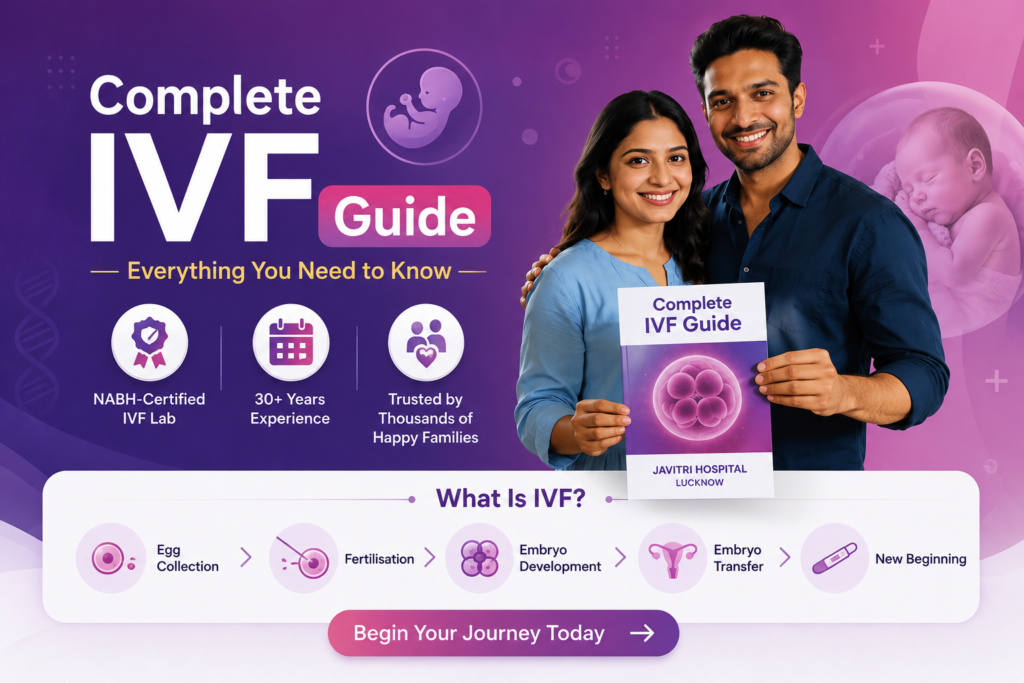
Complete IVF Guide
NABH-Certified IVF Lab
30+ Years Experience
What Is IVF?
Full Form, Meaning, Process & Everything You Need to Know
IVF — In Vitro Fertilisation — is the world’s most effective fertility treatment. This complete guide covers the full form, meaning, who needs it, the step-by-step process, success rates by age, types of IVF cycles, and how IVF works at Javitri Hospital, Lucknow.
1,50,000+
IVF Babies Born
First
Embryoscope in UP
4.9★
Google Rating
IVF (In Vitro Fertilisation) is a fertility treatment in which eggs are retrieved from the ovaries, fertilised with sperm in a laboratory, and the resulting embryo is transferred into the uterus. The full form of IVF is In Vitro Fertilisation — Latin for “fertilisation in glass.” It is also called a test tube baby procedure. IVF is the most effective and widely used form of Assisted Reproductive Technology (ART).
A typical IVF cycle takes 4–6 weeks. Success rates are 40–50% per cycle for women under 35 in India. IVF is used when natural conception or simpler treatments (IUI) have not succeeded, or when a specific medical cause requires it.
Section 01
IVF Full Form & Meaning — Clearly Explained
The full form of IVF is In Vitro Fertilisation. The phrase comes from Latin: in vitro means “in glass” — referring to the laboratory dish where fertilisation takes place. Fertilisation means the union of an egg and a sperm cell to form an embryo.
In natural conception, fertilisation happens inside the fallopian tube. In IVF, the same biological event occurs outside the body — in a NABH-certified embryology laboratory under precise temperature, humidity, and atmospheric conditions. The resulting embryo is then transferred into the uterus, where it implants and develops into a pregnancy just as it would naturally.
| I — In | Inside (a laboratory environment) |
| V — Vitro | Latin: “in glass” — petri dish |
| F — Fertilisation | Union of egg and sperm to form an embryo |
| IVF (complete term) | Fertilisation outside the body, in a lab |
| US Spelling | In Vitro Fertilization (with ‘z’) |
| Medical Category | Assisted Reproductive Technology (ART) |
In the United States, the spelling is In Vitro Fertilization (with a ‘z’). In India, the UK, and most Commonwealth countries, the standard spelling is Fertilisation (with an ‘s’). The procedure and outcome are identical regardless of spelling.
The world’s first IVF baby — Louise Brown — was born in the UK in 1978. India’s first IVF baby, Kanupriya Agarwal (also called Durga), was born just 67 days later, also in 1978. Since then, over 8 million babies worldwide have been born through IVF.
IVF vs Test Tube Baby — Are They the Same Thing?
Yes — a test tube baby and an IVF baby are exactly the same. “Test tube baby” is the popular term for a baby born through In Vitro Fertilisation (IVF). The phrase originated in the 1970s when the procedure was developed, and the association with laboratory glassware gave rise to the term.
Modern IVF laboratories use petri dishes, not test tubes — but the popular term “test tube baby” has stayed in common usage, especially in India. There is no medical, biological, or developmental difference between a test tube baby and a naturally conceived child. The method of fertilisation is the only difference. Everything after that — the pregnancy, delivery, and development of the child — is completely identical.
📌 Important: Children born through IVF are completely healthy and normal. The method of conception does not affect a child’s development, intelligence, or long-term health in any way.
In Hindi, IVF is most commonly called टेस्ट ट्यूब बेबी (test tube baby) or IVF ka ilaj / IVF treatment. Both refer to In Vitro Fertilisation. See also: IVF Kya Hai — Complete Hindi Guide →
Section 03
Who Needs IVF Treatment?
IVF is recommended when simpler fertility treatments have not worked, or when a specific medical condition makes natural conception unlikely. A fertility specialist at Javitri Hospital’s IVF centre in Lucknow determines the right treatment after a thorough diagnostic workup — semen analysis, hormonal profiling, tubal assessment, and uterine evaluation.
The most common indications for IVF are:
🔗
Blocked or Damaged Fallopian Tubes
Blocked tubes prevent egg and sperm from meeting naturally. IVF bypasses the tubes entirely by retrieving eggs directly from the ovaries.
🔬
Male Factor Infertility
Low sperm count, poor motility, or absent sperm — ICSI with IVF achieves fertilisation with as few as one sperm. Male infertility treatment →
❓
Unexplained Infertility
Couples trying for 12+ months (6 months if over 35) with all investigations normal. IVF provides the highest per-cycle success of any fertility treatment.
🌸
Endometriosis
Endometriosis affects egg quality and the uterine environment. IVF bypasses these factors by retrieving and fertilising eggs in a controlled laboratory setting.
⏰
Low Ovarian Reserve / Early Menopause
Women with low egg count (low AMH, high FSH) can attempt IVF with their own eggs, or use donor eggs when needed. Donor egg IVF →
🔄
Recurrent Miscarriage
Two or more miscarriages may benefit from IVF with preimplantation genetic testing (PGT) to transfer chromosomally normal embryos.
🧬
Genetic Conditions
Couples who carry genetic disorders use IVF with PGT to screen embryos before transfer — reducing the risk of passing conditions to the child.
❌
Failed IUI Cycles
When 3–4 IUI cycles have failed, IVF is the recommended next step. IVF delivers significantly higher success rates than IUI per cycle.
Not sure if IVF is right for you?
A single consultation at Javitri Hospital is all it takes to understand your diagnosis and the right treatment path.
Section 04
The IVF Process — Step by Step
A complete IVF cycle involves 7 distinct stages, spread over approximately 4–6 weeks. Here is exactly what happens at each step — and what you should expect as a patient:
1. Ovarian Stimulation — Days 2 to 12
Daily hormone injections (gonadotropins — FSH and/or LH) are administered to stimulate the ovaries to produce multiple mature eggs. In a natural cycle, just one egg is released. IVF aims to retrieve 8–15 mature eggs per cycle. Injections typically begin on Day 2 or 3 of your period and continue for 10–14 days. Your specialist tailors the protocol and dose to your individual ovarian reserve and response.
2. Monitoring — Ultrasound & Blood Tests
Regular transvaginal ultrasound scans and blood tests (oestradiol levels) are performed every 2–3 days during stimulation to track follicle growth. The stimulation dose is adjusted based on your response. Monitoring appointments at Javitri Hospital are available at both the Telibagh main centre and Badshahnagar evening clinic.
3. Trigger Injection — 36 Hours Before Retrieval
When follicles reach the right size (18–20 mm), a “trigger injection” (hCG or GnRH agonist) is given. This causes the final maturation of the eggs. Egg retrieval is precisely timed to occur 34–36 hours later, just before ovulation would naturally occur. Full guide to IVF injections →
4. Egg Retrieval (OPU — Ovum Pick-Up)
Eggs are collected under mild sedation — you are comfortable throughout and feel nothing during the procedure. A thin needle, guided by transvaginal ultrasound, is passed through the vaginal wall into each ovarian follicle. The procedure takes 15–20 minutes. You rest for 1–2 hours and go home the same day. Most patients experience only mild bloating or cramping afterwards, which settles within a day or two.
5. Fertilisation in the Embryology Laboratory
On the same day as retrieval, your partner provides a semen sample. In the NABH-certified embryology lab, the embryologist identifies mature eggs and combines them with prepared sperm. In standard IVF, eggs and sperm are placed together in a dish. In ICSI, a single sperm is injected directly into each egg — used when sperm quality or count is a concern. Fertilisation is confirmed the following morning.
6. Embryo Development & Culture — Days 1 to 5
Fertilised eggs (zygotes) are cultured in a specialised incubator that precisely replicates the conditions of the fallopian tube. The embryologist assesses their development on Days 2, 3, and 5. The highest-quality embryos reach the blastocyst stage on Day 5 — which carries the highest implantation potential and is what Javitri Hospital’s blastocyst transfer programme is built around.
7. Embryo Transfer & Pregnancy Test
The best-quality embryo is placed into the uterus using a thin, soft catheter — a gentle procedure that takes only a few minutes, requires no anaesthesia, and is similar in sensation to a routine smear test. You can walk out and resume light activity the same day. A blood beta-HCG pregnancy test is done 14 days after the transfer. If positive, an ultrasound is scheduled 2 weeks later to confirm a heartbeat. Full embryo transfer guide →
← Swipe to scroll →
| Stage | Duration | What Happens |
|---|---|---|
| Stimulation | 10–14 days | Daily hormone injections to grow multiple follicles |
| Monitoring | Throughout stimulation | Ultrasound + blood tests every 2–3 days |
| Trigger injection | Day 10–14 | Final egg maturation; retrieval scheduled 36 hours later |
| Egg retrieval | ~20 minutes | Minor procedure under sedation |
| Fertilisation | Same day as retrieval | Eggs + sperm combined in the lab (IVF or ICSI) |
| Embryo culture | 3–5 days | Embryo grows to Day 3 or blastocyst (Day 5) |
| Embryo transfer | ~10 minutes | Best embryo placed into the uterus |
| 2-week wait | 14 days | Progesterone support; await pregnancy test |
| Total cycle | 4–6 weeks | — |
Section 05
Types of IVF Cycles — Which One Is Right for You?
The type of IVF cycle recommended depends on your age, ovarian reserve, previous response to treatment, and specific diagnosis. Your Javitri Hospital specialist will advise the most suitable approach at your initial consultation.
Conventional (Full Stimulation) IVF
The standard IVF protocol, using hormone injections to stimulate multiple egg production. This gives the highest number of eggs per cycle, and consequently the best chance of having spare embryos to freeze for future attempts. Recommended for most patients under 40 with adequate ovarian reserve. This is the most common type performed at Javitri Hospital’s IVF centre.
Natural Cycle IVF
No (or very minimal) stimulation injections — the single egg that naturally develops in your cycle is retrieved and fertilised. Suitable for women who respond poorly to stimulation, have ethical objections to multiple embryo creation, or have certain medical conditions. Lower medication burden but fewer embryos per cycle means fewer chances per attempt.
Mini IVF (Minimal Stimulation IVF)
Lower doses of stimulation drugs than conventional IVF — typically retrieving 2–5 eggs. A middle ground between natural and conventional IVF. Used for women with poor ovarian reserve, or where a gentler protocol is medically preferred.
Frozen Embryo Transfer (FET) Cycle
When spare embryos are frozen (vitrified) from a previous IVF cycle, they can be thawed and transferred in a subsequent cycle without repeating stimulation and retrieval. FET cycles have excellent success rates, often matching or surpassing fresh transfers. See: Fresh vs frozen embryo transfer →
Donor Egg IVF
When a woman’s own eggs cannot be used (premature ovarian failure, very low AMH, or advanced age), eggs from a screened anonymous donor are fertilised with the partner’s sperm and transferred into the woman’s uterus. Donor egg IVF has the highest per-cycle success rates — 55–65%. Donor egg IVF — complete guide →
IVF with ICSI
ICSI (Intracytoplasmic Sperm Injection) is used in combination with IVF when male factor infertility is present. Javitri Hospital uses a computerised ICSI system that improves injection precision and fertilisation outcomes, even with very low or surgically retrieved sperm.
Section 06
IVF vs ICSI vs IUI — What Is the Difference?
The three most common fertility treatments in India are IUI, IVF, and ICSI. Patients often hear all three and find them confusing. Here is a clear comparison:
← Swipe to scroll →
| Feature | IUI | IVF | ICSI |
|---|---|---|---|
| Where fertilisation happens | Inside the uterus | Lab (outside body) | Lab (outside body) |
| Egg retrieval required? | No | Yes | Yes |
| How sperm fertilises egg | Naturally, in uterus | Placed together in dish | 1 sperm injected into 1 egg |
| Best for | Mild male factor, unexplained | Blocked tubes, moderate male factor | Severe male factor, very low sperm count |
| Success rate per cycle (India, <35) | 10–20% | 40–50% | 40–50% |
| Approximate cost (India) | ₹10,000–₹25,000 | ₹1,00,000–₹2,00,000 | ₹1,20,000–₹2,20,000 |
In practice, IVF and ICSI are commonly performed together — the egg retrieval, lab fertilisation, embryo culture, and transfer steps are all identical. The only difference is the method of fertilisation. At Javitri Hospital, the decision between standard IVF and ICSI is made based on sperm analysis results at the time of retrieval. Full comparison: IVF vs ICSI vs IUI — Complete Guide →
Section 07
IVF Success Rates in India — What to Expect
IVF success rates vary significantly with a woman’s age, because egg quality and quantity decline over time. Below are the typical IVF success rates per cycle in India at NABH-accredited centres:
← Swipe to scroll →
| Age Group | Live Birth Rate / Cycle | Clinical Pregnancy Rate | Notes |
|---|---|---|---|
| Under 35 | 40–50% | 45–55% | Best outcomes; highest egg quality & reserve |
| 35–37 | 30–38% | 35–42% | Moderate decline in egg quality |
| 38–40 | 20–28% | 25–32% | Noticeable reduction in egg quality |
| 41–42 | 10–15% | 12–18% | Donor eggs may be discussed |
| Over 42 | 5–8% | 7–10% | Donor egg IVF strongly recommended |
| Donor Egg IVF | 55–65% | 60–70% | Highest success rates — eggs from young donor |
These are per-cycle figures. Cumulative success across 3 IVF cycles reaches 70–80% for women under 38. Full IVF success rate guide →
📌 Success rates at Javitri Hospital are above the national average — supported by a NABH-certified embryology lab, computerised ICSI, blastocyst culture, and 30+ years of clinical expertise under Dr. Rajul Tyagi.
Section 08
What Affects IVF Success? Key Factors
Factors You Can Influence
- Age of the woman: The single most important factor. Women under 35 have the best outcomes. Acting sooner rather than later significantly improves your chances.
- Body weight: Both underweight and overweight affect hormone levels, ovarian response, and implantation. A BMI between 18.5–30 is associated with better IVF outcomes.
- Smoking: Smoking significantly reduces egg quality, embryo quality, and IVF success rates. Stopping at least 3 months before IVF is strongly recommended.
- Alcohol: Regular alcohol consumption reduces IVF success rates. Abstinence during stimulation and the 2-week wait is advised.
- Sperm DNA fragmentation: High sperm DNA damage is associated with IVF failure even when standard semen analysis looks normal. DFI testing identifies this. Treatment with antioxidants can reduce fragmentation before the IVF cycle. Male infertility & DFI testing at Javitri →
Clinical Factors
- Embryo quality: The quality of the embryo transferred is the most predictive clinical factor. Day 5 blastocyst transfer has higher implantation rates than Day 3 cleavage-stage transfer.
- Endometrial receptivity: The uterine lining must be appropriately prepared and receptive to accept the embryo. ERA (Endometrial Receptivity Analysis) testing can identify the optimal transfer window in difficult cases.
- Ovarian response: Women with very low ovarian reserve (low AMH) may produce fewer eggs per cycle. Protocol adjustments — such as adding growth hormone — can improve response.
- Laboratory quality: Air quality control, incubator precision, and embryologist experience directly affect embryo survival and development. All procedures at Javitri Hospital’s embryology laboratory are performed under NABH-certified quality protocols.
Get a personalised success assessment
Dr. Rajul Tyagi will review your investigations and give you an honest, specific estimate of your IVF success probability.
Section 09
IVF Treatment at Javitri Hospital, Lucknow
Javitri Hospital has been Lucknow’s most trusted fertility centre for over 30 years. Founded and led by Dr. Rajul Tyagi — MD (Obs & Gyn), KGMU — with advanced training at Cleveland Clinic Ohio USA and University Hospital Brussels Belgium — the hospital provides the complete range of IVF treatments under a single roof.
30+
IVF expertise
NABH
lab
4.9★
reviews
Free
consultation
🔬
NABH-Certified Lab
All embryology, sperm prep, and cryopreservation under NABH-certified quality protocols with strict air quality control.
🖥️
Computerised ICSI
Computer-assisted ICSI system for maximum injection precision — improving fertilisation rates especially in male factor cases.
🧬
Blastocyst Culture
Day 5 blastocyst culture — selecting the highest-quality embryo for transfer, improving implantation rates.
🩺
All Surgical Options
TESA, PESA, MESA, TESE available for male factor cases where sperm must be surgically retrieved. Learn more →
💳
IVF on EMI
Flexible payment plans available. No-cost EMI on IVF packages →
📍
3 Clinics
Telibagh main IVF centre (9 AM–5 PM), Badshahnagar Lucknow (5 PM–8 PM), and Swaroop Nagar Kanpur (9 AM–5 PM).
Javitri Hospital Mein Free Consultation Book Karein
Hamari team kuch ghanton mein call karti hai. Poori tarah confidential. Koi pressure nahi.
📋 What’s in this guide
- IVF Full Form & Meaning
- IVF vs Test Tube Baby
- Who Needs IVF?
- The IVF Process — Step by Step
- Types of IVF Cycles
- IVF vs ICSI vs IUI
- IVF Success Rates in India
- What Affects Success?
- IVF at Javitri Hospital
- Frequently Asked Questions
Free consultation book karein — call karein ya message bhejein.
Frequently Asked Questions About IVF
IVF stands for In Vitro Fertilisation. It is a fertility treatment in which eggs are retrieved from the ovaries, fertilised with sperm in a laboratory, and the resulting embryo is transferred into the uterus. IVF is the most effective form of Assisted Reproductive Technology (ART) and is commonly called a “test tube baby” procedure.
The full form of IVF is In Vitro Fertilisation. “In vitro” is Latin for “in glass” — referring to the laboratory petri dish where fertilisation occurs. It means fertilisation that takes place outside the human body, in a controlled laboratory environment, rather than inside the fallopian tube as happens in natural conception.
Yes — completely. “Test tube baby” is the popular term for a baby born through IVF. There is no medical or biological difference. The pregnancy, delivery, and development of the child are identical to naturally conceived children.
A complete IVF cycle takes approximately 4–6 weeks from the start of stimulation injections to the pregnancy test. This includes 10–14 days of stimulation, egg retrieval (one day), embryo culture (3–5 days), embryo transfer (one procedure), and a 14-day wait before the blood pregnancy test.
Many couples conceive within 1–3 IVF cycles. The cumulative success rate across 3 cycles is 70–80% for women under 38. Some succeed on the first cycle; others need 2–3 attempts. Your specialist at Javitri Hospital can give a personalised estimate based on your age, diagnosis, and investigation results.
Most patients describe IVF as uncomfortable rather than painful. The stimulation injections cause mild local discomfort. Egg retrieval is done under sedation — you feel nothing during the procedure. Mild bloating and cramping after retrieval settles in 1–2 days. The embryo transfer takes only a few minutes and is typically painless. Full guide: Is IVF Painful? →
IVF success rates in India are approximately 40–50% per cycle for women under 35, 30–35% for ages 35–37, 20–25% for 38–40, and 5–10% for women over 42. Donor egg IVF reaches 55–65% per cycle.
In standard IVF, eggs and sperm are placed in a dish together and fertilisation happens naturally. In ICSI (Intracytoplasmic Sperm Injection), a single sperm is injected directly into each egg. ICSI is used when sperm count is very low, motility is poor, or sperm are surgically retrieved. At Javitri Hospital, ICSI is performed using a computerised system for maximum precision.
Start Your IVF Journey at Javitri Hospital, Lucknow
30+ years of expertise. NABH-certified lab. Free first consultation. Call today.