
The IVF Process: A Complete Step-by-Step Guide
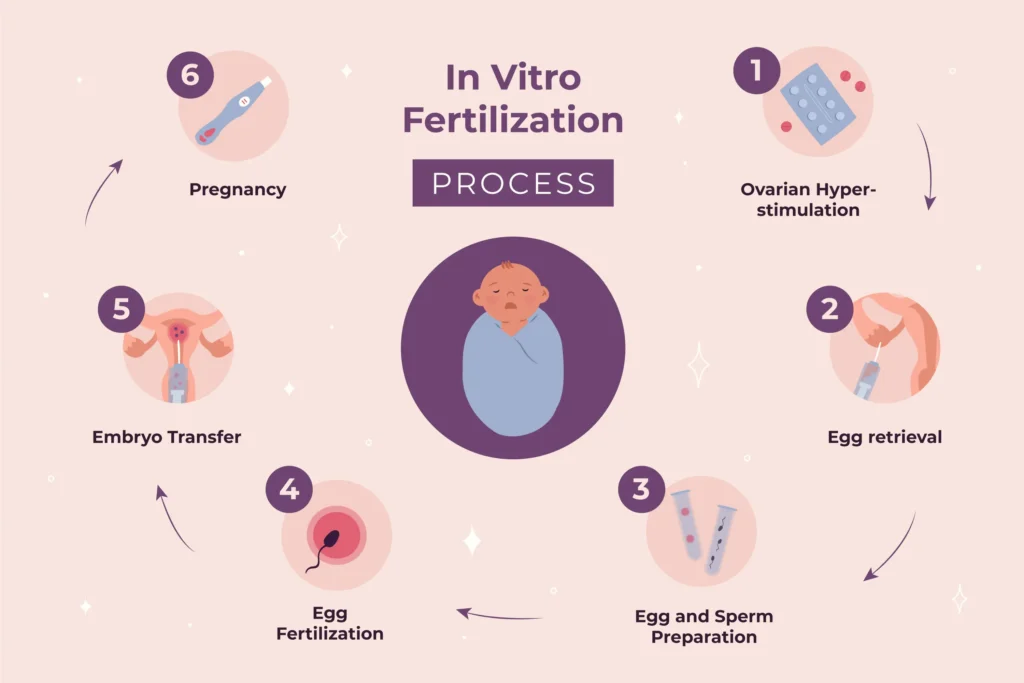
What exactly happens during IVF?”is one of the first questions couples ask. The IVF process is a sequence of five carefully managed steps — each building on the last — that take approximately 4–6 weeks from start to pregnancy test. Below, every step is explained clearly: what happens, how long it takes, and what to expect.
BEFORE THE IVF PROCESS BEGINS
Step 0: Pre-Treatment Evaluation and Protocol Planning
Before any injections begin, the IVF process starts with a thorough evaluation for both partners. This baseline stage is the most important — because the entire protocol is built on its findings.
Female Partner Tests
- Transvaginal ultrasound — ovarian reserve (antral follicle count) and uterine cavity check
- AMH blood test — most reliable marker of egg quantity
- Hormone profile — FSH, LH, estradiol, TSH, prolactin on Day 2–3 of the cycle
- Review of previous HSG, laparoscopy, or chromosomal results if applicable
Male Partner Tests
- Fresh semen analysis — count, motility, morphology (WHO 2021 reference values)
- DNA fragmentation index (DFI) — recommended if previous results were poor or IVF has failed
- Hormonal profile — testosterone, FSH, LH if indicated
💡 Key point: The protocol is never one-size-fits-all. A woman with PCOS needs a very different stimulation approach to one with low ovarian reserve. At Javitri Hospital, the first consultation includes a complete walkthrough of your personalised IVF protocol.
STEP 1 Ovarian Stimulation
8–14 days of daily hormone injections — monitored with 3–5 ultrasound scans
In a natural cycle, one egg matures per month. Ovarian stimulation uses daily hormone (gonadotropin) injections to develop multiple eggs simultaneously — giving the embryology team the best possible material to work with.
The injections use fine needles into the lower abdomen — rated 1–2 out of 10 on discomfort by most patients. The more notable discomfort is bloating as the ovaries enlarge, typically peaking in the last 2–3 days before retrieval.
Monitoring During Stimulation
- Transvaginal ultrasound scans every 2–3 days to track follicle growth
- Blood estradiol tests to confirm follicles are maturing correctly
- Stimulation dose is adjusted based on your response throughout the phase
The Trigger Injection
- Given when dominant follicles reach 17–20mm
- Completes final egg maturation — 34–36 hours before scheduled retrieval
- Type: hCG or GnRH agonist — chosen based on OHSS risk assessment
⚠️ OHSS Awareness: Women with PCOS or high antral follicle count are monitored closely during stimulation. Modern protocols — including GnRH agonist triggering and freeze-all strategies — have made severe OHSS very rare at Javitri Hospital.
STEP 2 Egg Retrieval
OPU — 15–30 minutes under IV sedation — same-day discharge
Egg retrieval (OPU — Ovum Pick-Up) is the most procedurally involved step of the IVF process. Under IV sedation, a fine needle guided by ultrasound passes through the vaginal wall into each ovarian follicle to aspirate the eggs.
At Javitri Hospital, egg retrieval is performed under intravenous sedation or general anaesthesia — you are asleep and feel nothing. You rest in recovery for 1–3 hours and go home the same day.
After Egg Retrieval — What to Expect
- Mild cramping similar to period pain for 24–48 hours — controlled with standard pain relief
- Light spotting or watery vaginal discharge for 1–2 days — normal
- Male partner provides semen sample same day; or prepared frozen/retrieved sperm is used
- Embryologist contacts you the following morning with a fertilisation report
STEP 3 Fertilisation — IVF or ICSI
In the NABH-certified embryology laboratory — fertilisation confirmed Day 1
Retrieved eggs move immediately to the embryology laboratory, where they are fertilised with prepared sperm. The method is chosen before the cycle based on your diagnosis.
Conventional IVF
Prepared sperm and mature eggs are placed together in a culture dish. Fertilisation happens naturally — the strongest sperm penetrates the egg. Used when sperm parameters are normal.
ICSI — Intracytoplasmic Sperm Injection
A single healthy sperm is injected directly into each mature egg using a micromanipulation needle. Recommended for:
- Male factor infertility — low count, poor motility, abnormal morphology
- Surgically retrieved sperm — TESA, PESA, MESA, TESE
- Previous fertilisation failure with conventional IVF
- High sperm DNA fragmentation (DFI)
💡 Javitri Hospital uses a computerised ICSI system — providing greater injection precision than manual ICSI, particularly valuable for challenging sperm samples. Fertilisation is confirmed approximately 16–18 hours later (Day 1 morning).
STEP 4 Embryo Culture and Development
3–6 days in controlled incubators — blastocyst culture and grading
Fertilised eggs are cultured in precisely controlled incubators that replicate the natural environment of the fallopian tube. This is where laboratory quality makes the greatest difference to IVF outcomes.
Day-by-Day Development
- Fertilisation confirmed — zygote stage Day 1
- Cleavage stage — 4 to 8 cells; graded by symmetry and fragmentation Day 2–3
- Morula — cells compact together Day 4
- Blastocyst — fluid cavity forms; ready for transfer or vitrification (freezing) Day 5–6
Why Blastocyst Culture Matters
Growing embryos to day 5 allows selection of only those with the strongest developmental potential. Not all embryos reach blastocyst — only those with the best chromosomal integrity tend to. This makes blastocyst transfer the preferred approach at Javitri Hospital for most patients.
💡 Optional at this stage: PGT (Preimplantation Genetic Testing) to screen for chromosomal abnormalities; assisted hatching to improve implantation. Surplus good-quality embryos can be vitrified (frozen) for future FET cycles.
STEP 5 Embryo Transfer and the Two-Week Wait
A few minutes — typically painless — then 11–14 days until the pregnancy blood test
The final active step of the IVF process. A thin, soft catheter carrying the selected embryo is passed gently through the cervix into the uterus under ultrasound guidance. Most patients describe it as similar to a routine cervical smear — brief and painless.
After transfer, you rest briefly at the clinic and go home. Normal light activities resume the same day. Complete bed rest is not needed.
The Two-Week Wait (2WW)
- Continue all prescribed medications — progesterone support, estrogen if prescribed
- Avoid heavy exercise, alcohol, hot baths, and saunas
- Symptoms — or their absence — do not reliably predict the result
- A beta-hCG blood test at the clinic (Day 11–14) gives the definitive result
💡 Important: Home urine tests during the 2WW are unreliable after IVF — progesterone supplements and residual trigger injection hCG can cause false positives. Always wait for the clinic blood test.
SIGN TO CONTACT
When to Contact Your Clinic During the IVF Process
Most experiences during the IVF process are normal and expected. Contact Javitri Hospital immediately if you notice:
- Severe abdominal pain or significant bloating — especially 3–7 days after egg retrieval (possible OHSS)
- Very reduced urine output after retrieval — a sign of fluid shift associated with OHSS
- Shortness of breath or chest pain in the days following retrieval
- Fever above 38°C at any point during or after procedures
- Heavy vaginal bleeding after embryo transfer — heavier than a normal period
⚠️ Do Not Wait: If you experience any of the above, call +91-9936068274 (Javitri Hospital) immediately or attend the nearest emergency room. OHSS is manageable and rarely serious when treated promptly.
FULL CYCLE TIMELINE
The Complete IVF Process Timeline
Use this reference timeline to plan your schedule and understand every appointment across the IVF process.
← Swipe to scroll →
| Phase / Step | Timing | What Happens | Duration |
|---|---|---|---|
| Pre-treatment Evaluation | 2–4 weeks before cycle | Blood tests, scans, semen analysis, protocol planning for both partners. | 1–2 weeks |
| Suppression (if needed) | Before stimulation | GnRH agonist or OCP to synchronise the cycle (not always required). | 2–4 weeks |
| Step 1 — Stimulation | Day 2 of period → ~Day 14 | Daily gonadotropin injections; ultrasound & blood monitoring every 2–3 days. | 8–14 days |
| Trigger Injection | ~36 hrs pre-retrieval | Final injection to complete egg maturation. | Single dose |
| Step 2 — Egg Retrieval | Retrieval Day (Day 0) | OPU under IV sedation; sperm sample collected same day. | 15–30 minutes |
| Step 3 — Fertilisation | Day 0 → Day 1 | IVF or ICSI in embryology lab; fertilisation confirmed next morning. | Overnight |
| Step 4 — Embryo Culture | Day 1 → Day 5/6 | Embryos develop to blastocyst; daily grading; optional PGT. | 3–6 days |
| Step 5 — Transfer | Day 3 or Day 5 | Best embryo placed into uterus under ultrasound guidance. | A few minutes |
| Two-Week Wait | 11–14 days post-transfer | Embryo implants; continue medications; avoid home testing. | 11–14 days |
| Pregnancy Blood Test | Day 11–14 after transfer | Beta-hCG blood test at clinic confirms result. | Same day result |
UNDERSTANDING THE PROCESS
Why the IVF Process Feels More Overwhelming Before You Begin
The majority of patients who complete an IVF cycle say the experience was less overwhelming than they feared before starting. Research consistently shows that anticipation of the IVF process — not the process itself — is the primary source of distress.
Understanding what happens at each step before your first injection measurably reduces both anxiety and the physical perception of discomfort. At Javitri Hospital, every couple receives a complete walkthrough of their protocol at the first consultation — so that every step is expected, not surprising.
💡 At Javitri Hospital: Call +91-9936068274 to book your free first consultation. Our team will walk you through your complete IVF protocol — what will happen, what you will feel, and what to watch for — before any treatment begins.
Have Questions About Your IVF Journey?
Speak with Dr. Rajul Tyagi’s team, we answer your questions about what to expect, what to prepare, and whether IVF is the right next step for you.
📋 Contents
- Step 0: Pre-Treatment Evaluation
- STEP 1 Ovarian Stimulation
- STEP 2 Egg Retrieval
- STEP 3 Fertilisation — IVF or ICSI
- STEP 4 Embryo Culture and Development
- STEP 5 Embryo Transfer and the Two-Week Wait
- Sing To Contact
- Full cycle Timeline
- IVF Process
- Frequently Asked Questions
Book a free consultation — call or send a message.
🔗 Related Articles
The IVF Process — FAQs
The IVF process is a series of medical steps that help couples conceive when natural conception has not been possible. It involves stimulating the ovaries to produce multiple eggs, retrieving them under sedation, fertilising them with sperm in a NABH-certified laboratory, culturing the resulting embryos to blastocyst stage, and transferring the best embryo into the uterus. A full IVF cycle takes 4–6 weeks.
The IVF process takes approximately 4–6 weeks per cycle — from the start of stimulation injections to the pregnancy blood test. This includes 8–14 days of stimulation, one day for egg retrieval, 3–6 days of embryo culture, and 11–14 days waiting after embryo transfer. A pre-treatment evaluation typically takes 1–2 additional weeks before the cycle begins.
: Step 1 — Ovarian stimulation: daily hormone injections grow multiple eggs over 8–14 days, monitored by ultrasound. Step 2 — Egg retrieval: mature eggs collected under sedation in 15–30 minutes. Step 3 — Fertilisation: eggs and sperm combined using IVF or ICSI. Step 4 — Embryo culture: embryos develop to blastocyst in controlled incubators over 3–6 days. Step 5 — Embryo transfer: the best embryo placed into the uterus, followed by a 2-week wait and blood pregnancy test.
Most steps of the IVF process involve minimal discomfort. Stimulation injections cause a brief sting (rated 1–2/10). The main discomfort is bloating during stimulation as the ovaries enlarge. Egg retrieval is done under IV sedation — you feel nothing. Embryo transfer is typically painless, comparable to a cervical smear. For most patients, the hardest part of the IVF process is emotional: the two-week wait.
The IVF process typically requires 8–12 clinic visits per cycle: the initial consultation and baseline scans, 3–5 monitoring scans during stimulation, the egg retrieval day (with 1–3 hours of recovery), the embryo transfer appointment, and the post-transfer pregnancy blood test. Most monitoring visits are brief — a scan and blood draw only.
In conventional IVF, eggs and prepared sperm are placed together in a dish and fertilisation happens naturally. In ICSI, a single healthy sperm is injected directly into each egg using a micromanipulation needle — used for male factor infertility, poor motility, surgically retrieved sperm, or previous fertilisation failure. Javitri Hospital uses a computerised ICSI system for greater precision.
IVF success rates depend primarily on the woman’s age and egg quality. Across India, live birth rates per cycle are approximately 40–50% for women under 35, declining to 20–35% for women 35–40, and further for women over 40. At Javitri Hospital, our NABH-certified embryology lab, computerised ICSI, and blastocyst culture protocol are designed to maximise outcomes at every stage.
During the IVF process, avoid: smoking and alcohol (both impair egg quality and IVF success rates); intense exercise — especially after egg retrieval and embryo transfer; hot baths, saunas, or steam rooms during the stimulation phase; starting new supplements or medications without informing your specialist. Continue all prescribed medications as directed and attend every scheduled monitoring appointment.
Yes. The IVF process can incorporate previously frozen sperm (from banking or surgical retrieval), frozen eggs, or frozen embryos (Frozen Embryo Transfer — FET). FET skips the stimulation and retrieval steps entirely, making the process shorter. Vitrified embryos stored at Javitri Hospital can be used in future FET cycles without repeating the full IVF process.
Javitri Hospital manages every step of the IVF process within a NABH-certified facility — including a dedicated embryology laboratory, computerised ICSI, blastocyst culture, and DNA fragmentation testing. Dr. Rajul Tyagi’s 30+ years of IVF expertise — with training at Cleveland Clinic USA and University Hospital Brussels — along with Dr. Archana Rastogi and Dr. Shivani Agarwal, ensures every protocol is personalised and every step is clearly explained before treatment begins.
Ready to Start IVF at Javitri Hospital, Lucknow?
We’ll walk you through exactly what to expect, before, during, and after each stage. Free consultation available.