
IVF vs IUI: Which Fertility Treatment Is Right for You
IVF vs IUI is usually the first real choice a couple faces after a fertility diagnosis. Both are proven treatments, but they differ in how they work, how much they cost, and how likely each is to result in pregnancy in a single cycle.
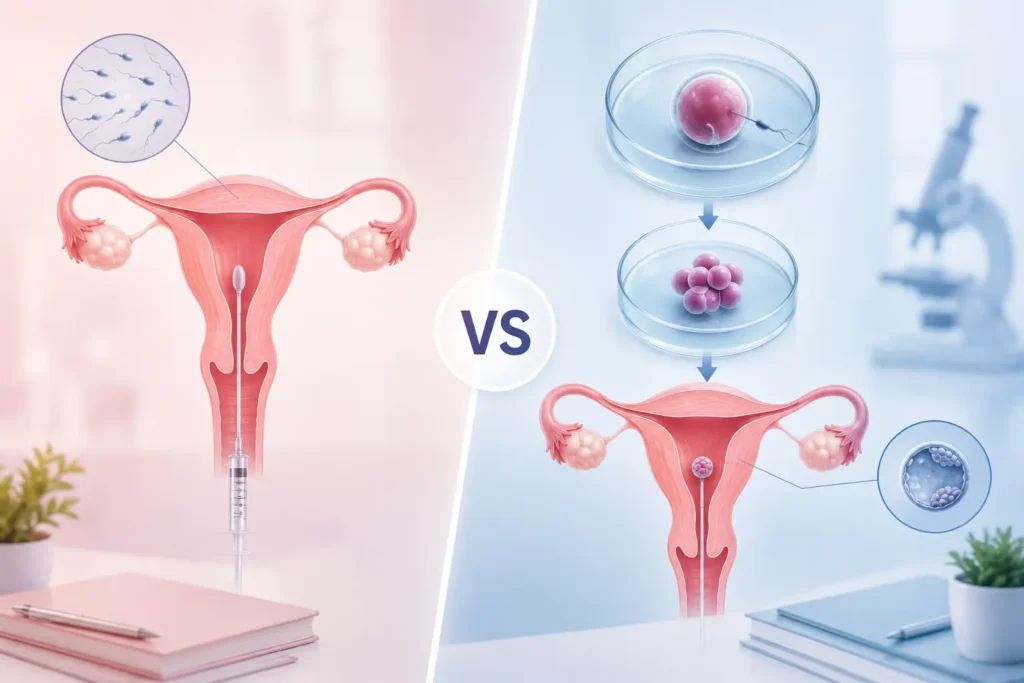
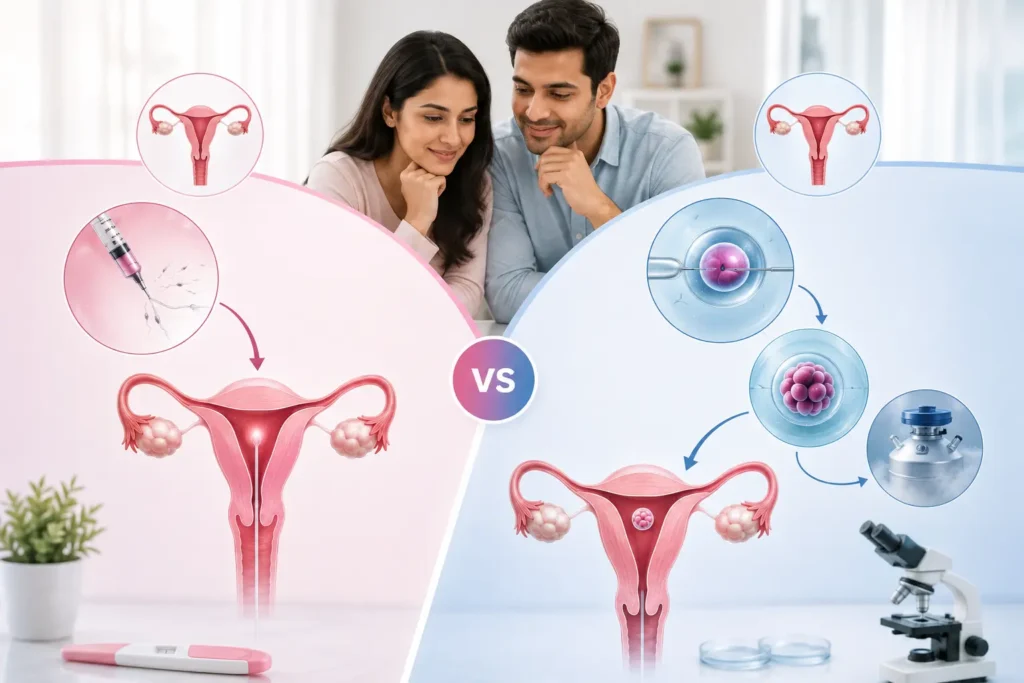
The core difference between IVF and IUI is where fertilisation happens. In IUI, prepared sperm is placed directly into the uterus and fertilisation happens naturally inside the body. In IVF, eggs are retrieved and fertilised with sperm in a laboratory, and the resulting embryo is transferred into the uterus. IUI gives nature a helpful head start. IVF takes over the steps nature cannot complete.
This guide explains both simply, compares success rates and cost side by side, and shows when each is usually recommended, so you can walk into your consultation ready to discuss the right option for your case rather than guessing between them.
| Where fertilisation happens | IUI: inside the body | IVF: in the laboratory |
| Invasiveness | IUI: a simple, quick procedure | IVF: injections plus egg retrieval |
| Success per cycle | IUI: 10% to 20% | IVF: 40% to 50% under 35 |
| Cost per cycle | IUI: from ₹20,000 | IVF: from ₹95,000 |
| Usually tried first | IUI, for mild and uncomplicated cases |
| Needed directly | IVF, for blocked tubes, severe male factor, or age over 38 |
Neither treatment is better in every situation. IUI is a gentle, affordable first step for the right candidates. IVF is more involved and costs more per cycle, but it is far more powerful and solves problems that IUI simply cannot. The right answer depends entirely on your diagnosis, which is what the rest of this guide unpacks.
What is IUI and How Does It Work?
IUI, or Intrauterine Insemination, places washed and concentrated sperm directly into the uterus around the time of ovulation. The idea is simple. By getting more healthy sperm closer to the egg at exactly the right moment, natural fertilisation has a better chance of happening.
A typical IUI cycle looks like this:
- Ovulation is tracked with ultrasound scans, sometimes with mild tablets or low dose injections to help one or two eggs mature.
- On the day of ovulation, the semen sample is washed in the laboratory, so inactive sperm and fluid are removed and only the most active sperm remain.
- The prepared sperm is placed into the uterus through a thin catheter, a brief and painless outpatient procedure with no anaesthesia.
- Two weeks later, a pregnancy test confirms the result.
IUI needs three things to work: at least one open fallopian tube, reasonable sperm quality, and eggs that ovulate. If any of these is missing, IUI cannot succeed however many cycles you try, and that single fact drives most IUI or IVF decisions. You can read more on our page for IUI treatment in Lucknow.
What is IVF and How Does It Work?
IVF, or In Vitro Fertilisation, takes fertilisation out of the body and into the laboratory. That is exactly why it works even when the tubes are blocked or the sperm cannot reach the egg on its own.
A typical IVF cycle involves:
- Around 10 to 14 days of hormone injections to stimulate the ovaries to produce several eggs rather than one.
- Egg retrieval, a short procedure done under anaesthesia.
- Fertilisation in the laboratory, where eggs and sperm are combined in a dish, or where a single sperm is injected into each egg using ICSI in male factor cases.
- Embryo culture for three to five days, often to the blastocyst stage for stronger embryo selection.
- Embryo transfer into the uterus, which is painless and needs no anaesthesia.
- A pregnancy test around two weeks later.
Because the specialist controls egg numbers, fertilisation, and embryo selection, IVF delivers the highest chance of pregnancy per cycle of any fertility treatment. Spare embryos can also be frozen, so a single stimulation can provide more than one transfer attempt. Learn more on our page for IVF treatment in Lucknow.
The Difference Between IVF and IUI, Point by Point
Here is the full difference between IVF and IUI across every factor that matters to couples making the decision.
← Swipe to scroll →
| Factor | IUI | IVF |
|---|---|---|
| Fertilisation | Inside the body, in the fallopian tube | In the laboratory, embryo transferred to the uterus |
| Procedure | A quick catheter insemination, no anaesthesia | Injections, egg retrieval under anaesthesia, transfer |
| Medication | None or mild tablets, or low dose injections | 10 to 14 days of hormone injections |
| Timeline per cycle | About two to three weeks | About four to six weeks |
| Success per cycle | 10% to 20%, age dependent | 40% to 50% under 35, age dependent |
| Cost per cycle | From ₹20,000 | From ₹95,000 |
| Needs open tubes | Yes, at least one open tube is essential | No, IVF bypasses the tubes completely |
| Works for severe male factor | No, it needs reasonable count and motility | Yes, with ICSI even very low counts can work |
| Embryo freezing | Not possible, no embryos are created | Possible, spare embryos frozen for later |
| Typical role | First line treatment for mild cases | Definitive treatment for complex cases or after IUI fails |
The pattern is clear. IUI assists the natural process, while IVF replaces the steps the body cannot manage on its own. That is why fertility specialists describe them as different rungs on the same ladder rather than as rival choices.
IUI Success Rate by Age
The IUI success rate in India is generally 10% to 20% per cycle, and it moves with the factors below. These are broad averages rather than a promise for any one person.
- Under 35: the highest chance, roughly 15% to 20% per cycle.
- Ages 35 to 40: the chance dips to around 10% per cycle.
- Over 40: the chance usually falls below 5% per cycle, and many specialists advise moving directly to IVF to save time.
- Sperm quality matters too. IUI works best when the washed total motile count is healthy. Very low counts make IUI unlikely to succeed.
The most useful number in IUI is not the single cycle figure but the cumulative one. Most IUI pregnancies happen within the first three cycles, and cumulative success over three to four properly timed cycles can reach 30% to 40% for good candidates. If three, or at most six, well monitored cycles have not worked, continuing rarely helps, and IVF becomes the evidence based next step. Spending a year on repeated IUI is one of the costliest mistakes couples make, especially after 35 when every month matters.
IVF Success Rate by Age
The IVF success rate is generally two to three times higher than IUI per cycle, and it also depends heavily on age and laboratory quality. Broad averages look like this.
- Under 35: roughly 40% to 50% per cycle.
- Ages 35 to 37: roughly 30% to 35% per cycle.
- Ages 38 to 40: roughly 20% to 25% per cycle.
- Ages 41 to 42: roughly 12% to 18% per cycle.
IVF reaches these higher figures for structural reasons. Several eggs are collected instead of one, fertilisation is confirmed in the laboratory rather than left to chance, the strongest embryo is selected for transfer, ICSI rescues male factor cases, and frozen embryos add further attempts from a single stimulation. Cumulative success over three cycles for younger women can reach 60% to 80%. Laboratory technology such as time lapse embryo monitoring and blastocyst culture measurably improves outcomes, which is why the choice of an accredited IVF centre in Lucknow matters more here than in any other fertility treatment.
💡 A fair way to weigh the two: three IUI cycles cost less overall but carry a modest cumulative chance, while a single IVF cycle costs more yet offers a much higher chance in one go, plus frozen embryos for the future. For young couples with mild issues, IUI first makes sense. For couples over 35 or with complex diagnoses, IVF is usually the faster and ultimately cheaper route to a baby.
IUI vs IVF Cost
| IUI per cycle | From ₹20,000 |
| Three IUI cycles (a typical course) | ₹30,000 to ₹75,000 |
| IVF per cycle, all in | ₹1,20,000 to ₹1,80,000 (from ₹95,000 base) |
| ICSI add on, if male factor | ₹20,000 to ₹40,000 extra |
| EMI available | Yes, 0% interest at Javitri Hospital |
IUI is far cheaper per cycle, which is exactly why it is the right first step when the diagnosis supports it. But cost per cycle is the wrong measure. What matters is cost per baby. Paying for several failed IUI cycles before an inevitable IVF can cost more, in money and in time, than moving to IVF at the right moment. A good specialist will tell you honestly which category you fall into rather than defaulting to the more expensive option.
IUI or IVF, Which Should You Choose?
Here is the framework fertility specialists actually use. Start with the disqualifiers, then weigh age and history.
-
1. Choose IUI first if all of these are true
You are under 35, or under 38 with good ovarian reserve, at least one fallopian tube is open, sperm count and motility are normal or only mildly reduced, and the diagnosis is unexplained, ovulation related such as PCOS, or cervical. For this group, three IUI cycles is a sensible, affordable starting point.
-
2. Go straight to IVF if any of these apply
Both fallopian tubes are blocked or damaged, there is severe male factor infertility, you have moderate to severe endometriosis, ovarian reserve is low, or the woman is over 38. In these cases IUI has little chance, and every failed IUI cycle wastes fertile time.
-
3. Move from IUI to IVF after failed cycles
If three well monitored IUI cycles, or at most six for younger women, have not led to pregnancy, the data says stop. The chance of a fourth or fifth IUI is lower than the first three, while IVF remains far more effective. This is the single most common transition point in fertility treatment.
-
4. When age is against you, skip the ladder
After 35, and especially after 38, ovarian reserve declines each month. Spending six to nine months on IUI cycles with a small chance each can cost more than money. For couples in this group, most specialists recommend going straight to IVF, because it is the faster route and frozen embryos protect against further decline.
The honest truth is that no article can pick your treatment. Your tube status, semen analysis, ovarian reserve, and age together decide IUI or IVF, and a trustworthy centre will recommend the cheaper option when it genuinely fits rather than pushing everyone toward IVF.
How Male and Female Factors Change the Choice
The reason IVF vs IUI has no single answer is that the underlying diagnosis points to different treatments. Two areas matter most.
When the issue is on the male side, sperm quality sets the limit. IUI can help with a mildly reduced count or motility, because washing concentrates the best sperm. But when the count is very low, motility is poor, shape is abnormal, or sperm must be retrieved surgically, IUI has little chance and IVF with ICSI becomes the effective option. If a semen analysis has flagged concerns, our guidance on male infertility explains the tests and treatments in detail.
When the issue is on the female side, the anatomy and ovulation set the path. Open, healthy tubes and regular ovulation favour trying IUI first, while blocked tubes, low ovarian reserve, or moderate to severe endometriosis point toward IVF. Conditions such as PCOS often respond well to IUI combined with mild stimulation before IVF is considered. You can read more about the causes and treatments on our female infertility page.
This is why an accurate diagnosis comes before any treatment decision. The right test results, not a general rule, tell you whether to begin with IUI or move directly to IVF.
Javitri Hospital
IUI and IVF Treatment at Javitri Hospital, Lucknow
At Javitri Hospital, both treatments are available under one roof, so the recommendation is based on your diagnosis rather than on what a clinic happens to offer. With training, technology, and honest counselling behind every decision, you get a clear answer to the IUI or IVF question.
- ✅ IUI from ₹20,000, with personalised ovulation monitoring and expert semen preparation in a NABH accredited laboratory
- ✅ IVF from ₹95,000, with the first Embryoscope in Uttar Pradesh, blastocyst culture, and computerised ICSI
- ✅ Honest protocol advice, with IUI recommended when it genuinely fits, so you are never pushed to IVF unnecessarily
- ✅ Consultation fees of ₹600 with Dr. Rajul Tyagi, and ₹400 with Dr. Niharika Tyagi and Dr. Lavanya Tyagi
- ✅ 0% interest EMI across 3 month, 6 month, and 12 month plans
- ✅ Dr. Rajul Tyagi trained at Cleveland Clinic USA and Brussels University, caring for fertility patients since 1997
Address, Main Centre: Telibagh Chauraha, Raebareli Road, Lucknow 226025
Call: +91 99360 68274 | Email: info@javitrihospital.co.in
Still Deciding Between IUI and IVF? Get an Honest Answer.
Bring your reports and find out which treatment truly fits your case. Transparent advice. EMI available. Fully confidential.
Keep Reading
Related Fertility Guides
→ IUI Treatment in Lucknow, Process and Timing
→ IVF Treatment in Lucknow, How It Works
→ Choosing an IVF Centre in Lucknow
→ Male Infertility, Tests and Treatments
📋 In This Article
- What is IUI
- What is IVF
- Key Differences
- IUI Success Rate
- IVF Success Rate
- Cost Comparison
- IUI or IVF
- Your Diagnosis Decides
- Javitri Hospital
- FAQs
Book a consultation. Call us or send a message.
IVF vs IUI, Frequently Asked Questions
The main difference between IVF and IUI is where fertilisation happens. In IUI, prepared sperm is placed into the uterus and fertilisation happens naturally inside the body. In IVF, eggs are retrieved and fertilised with sperm in a laboratory, and the embryo is transferred into the uterus. IUI assists natural conception, while IVF replaces the steps the body cannot complete, which is why IVF works for blocked tubes and severe male infertility where IUI cannot.
IVF has a higher success rate per cycle. IVF is generally 40% to 50% under 35, while IUI is 10% to 20%, both depending on age and diagnosis. IVF is two to three times more effective in a single cycle because several eggs are used, fertilisation is confirmed in the laboratory, and the best embryo is selected for transfer. Over multiple gentler and cheaper cycles, IUI can still add up for the right candidates.
Try IUI first if you are under 35, at least one fallopian tube is open, sperm parameters are normal or only mildly reduced, and the diagnosis is unexplained or ovulation related. Go straight to IVF if both tubes are blocked, there is severe male infertility, ovarian reserve is low, the woman is over 38, or three or more IUI cycles have already failed. A specialist decides based on your tube status, semen analysis, ovarian reserve, and age.
Most specialists recommend a maximum of three IUI cycles, or up to six for young women with a good prognosis, before moving to IVF. Most IUI pregnancies happen within the first three cycles, after which per cycle success declines while IVF stays far more effective. Continuing IUI beyond this point usually wastes time and money, especially after age 35.
The IUI success rate is generally 10% to 20% per cycle. Under 35 it is around 15% to 20%, between 35 and 40 it dips to about 10%, and over 40 it usually falls below 5% per cycle. Cumulative success over three to four properly timed cycles can reach 30% to 40% for good candidates. These are broad averages and your own chance depends on your diagnosis and sperm quality.
IVF success is generally around 40% to 50% per cycle under 35, 30% to 35% between 35 and 37, 20% to 25% between 38 and 40, and 12% to 18% between 41 and 42. Cumulative success over three cycles for younger women can reach 60% to 80%. Laboratory quality and embryo selection also influence the outcome, which is why an accredited centre matters. Your specialist will give you a personalised estimate after reviewing your reports.
For mild male factor issues, such as a slightly low count or motility, IUI can help because sperm washing concentrates the healthiest sperm. For severe male infertility, such as a very low count, poor motility, abnormal shape, or surgically retrieved sperm, IUI has little chance and IVF with ICSI is the effective option. A semen analysis decides which applies, so it is one of the first tests a specialist will review.
IUI at Javitri Hospital starts from ₹20,000 per cycle, and a typical three cycle course runs about ₹30,000 to ₹75,000. IVF starts from ₹95,000, with an all in fresh cycle typically ₹1,20,000 to ₹1,80,000, and ICSI adds ₹20,000 to ₹40,000 when there is a male factor. IUI is much cheaper per cycle, but for complex cases IVF can be better value overall. 0% interest EMI is available. Call +91 99360 68274 for a personalised estimate.
Yes. A centre that offers both IUI treatment in Lucknow and IVF treatment in Lucknow under one roof can move you smoothly from one to the other if needed, using the same records, laboratory, and specialist. This continuity matters, because many couples begin with IUI and later progress to IVF, and starting over at a new clinic each time adds delay and repeated tests.
IUI is a brief, almost painless procedure, similar to a routine internal examination, with no anaesthesia. IVF involves more steps: a course of hormone injections, egg retrieval done under short anaesthesia so you feel nothing during it, and a painless embryo transfer. Most discomfort in IVF comes from the injections and mild bloating during stimulation, which settle quickly. Neither treatment is as difficult as many couples fear beforehand.
Find the Right Treatment, IUI or IVF, for Your Case
An honest recommendation based on your reports. Transparent cost. 0% interest EMI available. It starts with one call.