
Laparoscopy for Infertility and Family Planning
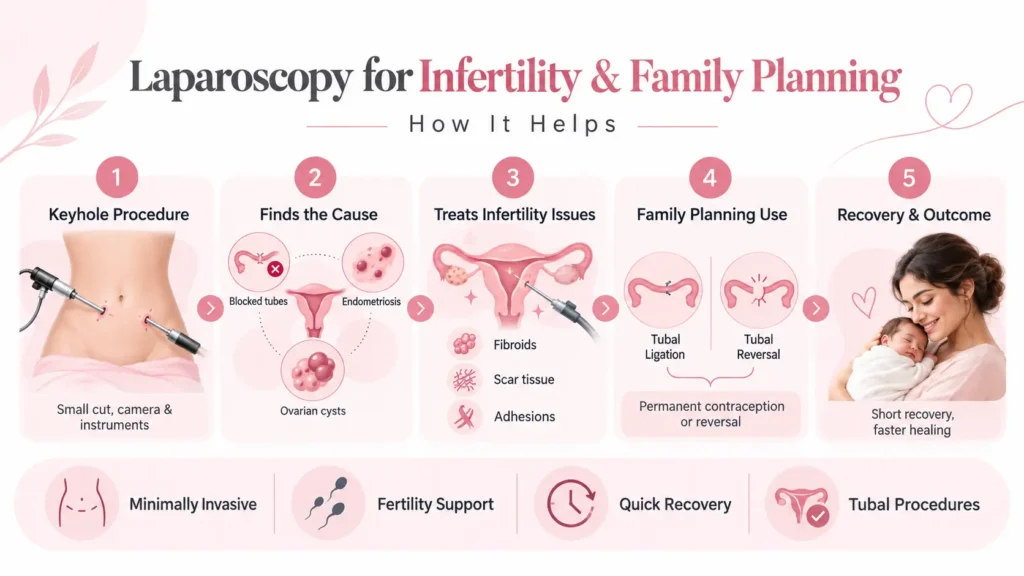
Laparoscopy is a minimally invasive keyhole surgery that lets doctors look inside the pelvis through a small cut and treat many problems in the same sitting. In fertility care it is used to find and fix the causes of infertility, and in family planning it is used for tubal procedures.
For infertility, laparoscopy can diagnose and treat blocked tubes, endometriosis, ovarian cysts, fibroids, and scar tissue, all of which can stop a woman from conceiving. For family planning, the same keyhole approach is used for permanent contraception and, when a couple changes their mind, for reversal.
This guide explains in simple language what laparoscopy does, how it helps fertility, its role in family planning, the cost in India, and the recovery. It is written to help you understand the procedure before you discuss it with a specialist.
| Type of surgery | Minimally invasive keyhole surgery |
| For infertility | Treats blocked tubes, endometriosis, cysts, fibroids, adhesions |
| For family planning | Tubal ligation, and reversal to restore fertility |
| Anaesthesia | General, as a day care or short stay procedure |
| Cost in India | ₹25,000 to ₹80,000, more if major treatment is done |
| Recovery | Desk work in 3 to 5 days, full activity in 1 to 2 weeks |
The big advantage of laparoscopy is that it is both a test and a treatment. In one procedure, the surgeon can see the exact problem and often correct it at the same time, through tiny cuts rather than a large open surgery. That means less pain, a shorter stay, and a faster recovery.
What is Laparoscopy?
Laparoscopy is a surgery done through very small cuts, usually 5 to 10 mm, instead of one large incision. A thin telescope with a camera, called a laparoscope, is passed through one cut, and fine instruments through others. The camera sends a clear, magnified view to a screen, so the surgeon can see inside the pelvis in detail.
Because the cuts are so small, laparoscopy is often called keyhole surgery. Compared with open surgery it means less pain, less blood loss, a lower risk of infection, a shorter hospital stay, and a much faster return to normal life. Most laparoscopy is done as a day care or overnight procedure under general anaesthesia.
In fertility care, this keyhole view is powerful because many causes of infertility sit on the surface of the ovaries, tubes, and pelvis, where a scan cannot always see them clearly. Laparoscopy shows them directly, and the surgeon can treat them in the same sitting. You can read more on our page for laparoscopy at Javitri Hospital.
Laparoscopy for Infertility: What It Treats
Laparoscopy for infertility is used to find the reason a woman is not conceiving and to treat it in the same procedure. These are the common problems it addresses.
- Blocked fallopian tubes. The surgeon can see and sometimes open blocked tubes, so the egg and sperm can meet. Learn more about blocked fallopian tubes.
- Endometriosis. Tissue growing outside the uterus can be removed or destroyed, which often improves the chance of conceiving and reduces pain.
- Ovarian cysts. An ovarian cyst that is affecting fertility can be drained or removed while protecting healthy ovarian tissue.
- Fibroids. Certain uterine fibroids that affect conception can be removed laparoscopically.
- Pelvic adhesions. Bands of scar tissue from past infection or surgery can be cut away to free the tubes and ovaries.
- PCOS. In selected cases of PCOS that do not respond to medication, a procedure called ovarian drilling can help restore regular ovulation.
Laparoscopy is not needed for every couple. It is most useful when there is a clear suspicion of one of these conditions, or when all other tests are normal but conception still has not happened after a year or more of trying.
Diagnostic Laparoscopy and the Dye Test
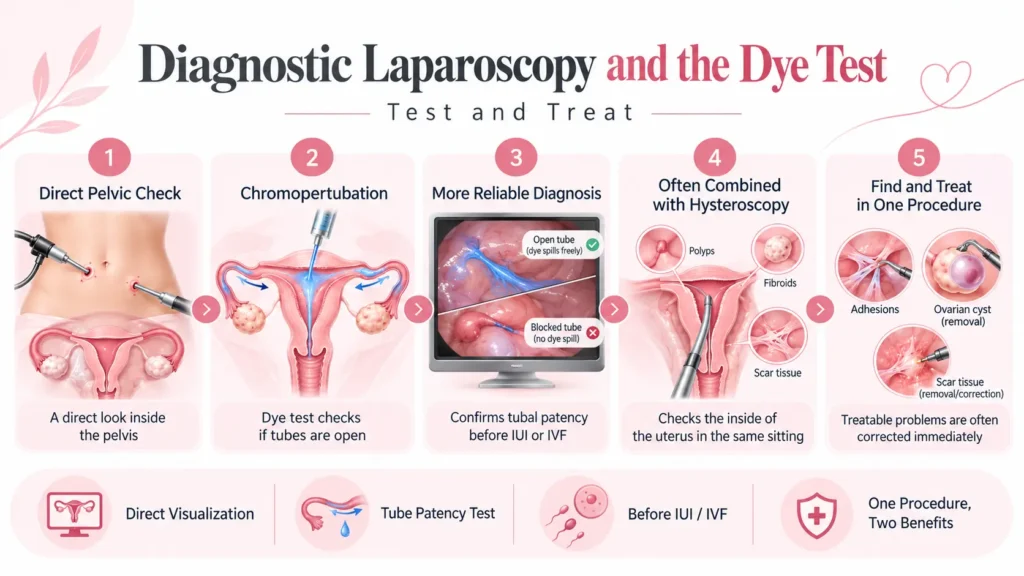
When the cause of infertility is unclear, a diagnostic laparoscopy gives a direct look inside the pelvis. During the procedure, a coloured dye is gently passed through the uterus and tubes, a test called chromopertubation. The surgeon watches on the screen to see if the dye flows freely through the tubes.
This dye test is more reliable than an ordinary tube scan, because the surgeon sees the tubes directly rather than relying on an image. It confirms whether the fallopian tubes are open, which is essential information before planning IUI or IVF. For a more complete check, laparoscopy is often combined with hysteroscopy, which inspects the inside of the uterus for polyps, fibroids, or scar tissue in the same sitting.
The real value is that a diagnostic laparoscopy rarely stays only a test. If the surgeon finds a treatable problem, such as adhesions or a cyst, it is usually corrected there and then, so one procedure both finds and fixes the issue.
Laparoscopy for Family Planning
Laparoscopy also has an important role in family planning, through tubal procedures. Laparoscopic surgery for family planning is used in two opposite situations, depending on what a couple wants.
- Permanent contraception. When a couple has completed their family, laparoscopic tubal ligation closes or seals the fallopian tubes to prevent future pregnancy. It is a safe, quick keyhole procedure with a fast recovery, which is why laparoscopy family planning is a trusted method of permanent birth control.
- Reversal to restore fertility. If a couple later changes their mind, laparoscopy can also be used to attempt a reversal, reconnecting the tubes to try to restore natural fertility. Success depends on how the original procedure was done and on the woman’s age.
Whether the goal is to prevent pregnancy or to restore fertility, the keyhole approach keeps the surgery gentle, with small cuts and a short recovery. A specialist will explain which option fits your situation and what to expect from it.
Laparoscopy Cost in India
The cost of laparoscopy depends mainly on whether it is a simple diagnostic procedure or a major treatment done at the same time. These are typical 2026 ranges in India.
← Swipe to scroll →
| Procedure | Typical Cost in India |
|---|---|
| Diagnostic laparoscopy | ₹25,000 to ₹50,000 |
| Laparoscopy with the dye test | ₹30,000 to ₹80,000 |
| With adhesion removal | Add ₹15,000 to ₹40,000 |
| With endometriosis or cyst treatment | ₹75,000 to ₹1,50,000 or more |
| Tubal ligation for family planning | ₹20,000 to ₹45,000 |
The cost rises with the complexity of what needs to be treated, because a longer, more detailed surgery uses more theatre time and skill. Lucknow is more affordable than metro cities for the same quality at an accredited centre. Always ask for a written, itemised estimate, and check whether anaesthesia and the hospital stay are included.
Laparoscopy Recovery
One of the biggest benefits of keyhole surgery is the quick recovery. Most women are back to normal life within days, not weeks. Here is a typical timeline.
- First 1 to 2 days: rest at home. Some bloating and a little shoulder tip discomfort are common, from the harmless gas used during surgery, and they settle quickly.
- 3 to 5 days: most women return to desk work and light routine.
- 1 to 2 weeks: a return to full physical activity.
- Trying to conceive: if it was only a diagnostic procedure, there is usually no delay. After adhesion removal, doctors often advise waiting about 4 to 6 weeks, and after endometriosis treatment about 4 to 12 weeks.
Recovery is faster and smoother than open surgery because the cuts are so small. Your surgeon will give you personalised advice on activity, medication, and when it is safe to try for a pregnancy, based on exactly what was done.
When is Laparoscopy Recommended?
Laparoscopy is a valuable tool, but it is not the first step for every couple, and an honest specialist will only advise it when there is a clear reason. It is commonly recommended when:
- There is a suspicion of endometriosis, often with pelvic pain.
- All other tests are normal but conception has not happened after 12 to 24 months of trying.
- A tube scan has given unclear results and the tubes need to be checked directly.
- There is a history of pelvic infection, appendicitis, or past abdominal surgery.
- An ovarian cyst or fibroid is affecting fertility and needs treatment.
For some couples, the better path is to move straight to IVF rather than surgery, especially when age or other factors matter. The right choice depends on your reports, which is why a full assessment comes first. Where a simpler treatment such as IUI fits, that may be tried too.
Javitri Hospital
Laparoscopy in Lucknow at Javitri Hospital
At Javitri Hospital, laparoscopy for infertility and family planning is performed with care, clear pricing, and an honest view of whether you need it. Here is what to expect.
- ✅ Diagnostic and operative laparoscopy for blocked tubes, endometriosis, cysts, fibroids, and adhesions
- ✅ The dye test and combined hysteroscopy, to check tubes and uterus together in one sitting
- ✅ Laparoscopic family planning, including tubal procedures, with a short recovery
- ✅ A written, itemised estimate, with anaesthesia and stay explained up front
- ✅ A NABH accredited theatre, with 0% interest EMI to spread the cost
- ✅ Care from Dr. Rajul Tyagi, trained at Cleveland Clinic USA and Brussels University, caring for fertility patients since 1997
Our main centre is at Telibagh, Lucknow, with further clinics at Badshahnagar and in Kanpur.
Address, Main Centre: Telibagh Chauraha, Raebareli Road, Lucknow 226025
Call: +91 99360 68274 | Email: info@javitrihospital.co.in
Considering Laparoscopy? Find Out If You Need It.
Bring your reports and get an honest view of whether laparoscopy is right for you, with a clear, itemised cost. Transparent advice. EMI available. Fully confidential.
📋 In This Article
- Overview
- What is Laparoscopy
- What It Treats
- Diagnostic and Dye Test
- For Family Planning
- Cost in India
- Recovery
- When It Is Recommended
- At Javitri Hospital
- FAQs
Find out if laparoscopy is right for you. Call us or send a message.
🔗 Related Articles
Laparoscopy for Infertility, Frequently Asked Questions
Laparoscopy for infertility is a keyhole surgery that lets a doctor look inside the pelvis through small cuts and treat the causes of infertility in the same sitting. It can find and fix blocked tubes, endometriosis, ovarian cysts, fibroids, and scar tissue. It is both a test and a treatment, done under general anaesthesia as a day care or short stay procedure with a fast recovery.
Laparoscopy can treat blocked fallopian tubes, endometriosis, ovarian cysts, certain uterine fibroids, and pelvic adhesions from past infection or surgery. In selected cases of PCOS that do not respond to medication, ovarian drilling during laparoscopy can help restore ovulation. The surgeon often finds and treats the problem in the same procedure.
During laparoscopy for blocked fallopian tubes, the surgeon sees the tubes directly and passes a coloured dye through them, a test called chromopertubation, to check if they are open. If a tube is blocked by scar tissue or adhesions, it can sometimes be opened in the same sitting. This direct view is more reliable than an ordinary tube scan for confirming whether the tubes are open.
Laparoscopy is used in family planning in two ways. For permanent contraception, laparoscopic tubal ligation seals the fallopian tubes to prevent future pregnancy. If a couple later wants a child, laparoscopy can also attempt a reversal by reconnecting the tubes to restore natural fertility. Both use the same gentle keyhole approach with a short recovery.
In ovarian cyst laparoscopic surgery, the surgeon views the ovary through the keyhole camera and either drains or removes the cyst while carefully protecting the healthy ovarian tissue. This matters in fertility care, because preserving the ovary protects the egg reserve. It is a minimally invasive procedure with much less pain and a faster recovery than open surgery.
A diagnostic laparoscopy in India typically costs ₹25,000 to ₹50,000, and ₹30,000 to ₹80,000 with the dye test. Adding adhesion removal costs ₹15,000 to ₹40,000 more, while endometriosis or cyst treatment can take the total to ₹75,000 to ₹1,50,000 or more. Tubal ligation for family planning costs around ₹20,000 to ₹45,000. The figure rises with the complexity of what is treated.
Recovery from laparoscopy is quick. Most women rest for the first one to two days, return to desk work in three to five days, and resume full activity within one to two weeks. Mild bloating and shoulder tip discomfort from the surgical gas settle quickly. Your surgeon will advise when it is safe to try for a pregnancy, based on exactly what was done.
Laparoscopy is done under general anaesthesia, so you feel nothing during the procedure. Afterwards, the small cuts cause far less pain than open surgery, and most discomfort comes from mild bloating or shoulder tip ache from the harmless gas used, which settles within a day or two. Simple pain relief is usually enough, and most women are comfortable within a few days.
Not always. Laparoscopy is recommended only when there is a clear reason, such as suspected endometriosis, unclear tube results, or an ovarian cyst or fibroid affecting fertility. For many couples, especially where age matters, moving straight to IVF is the better path. A full assessment of your reports decides whether laparoscopy adds value before treatment.
At Javitri Hospital in Lucknow, laparoscopy for infertility and family planning is performed in a NABH accredited theatre, covering blocked tubes, endometriosis, cysts, fibroids, adhesions, and tubal procedures. You receive a written, itemised estimate and an honest view of whether you need the surgery, with 0% interest EMI available. Call +91 99360 68274 to discuss your case.
Get an Honest View on Laparoscopy
Find out whether you really need it, with a clear, itemised cost and a fast recovery. Transparent care. EMI available. It starts with one call.