
Types of IVF Treatment — Which One is Right for You?
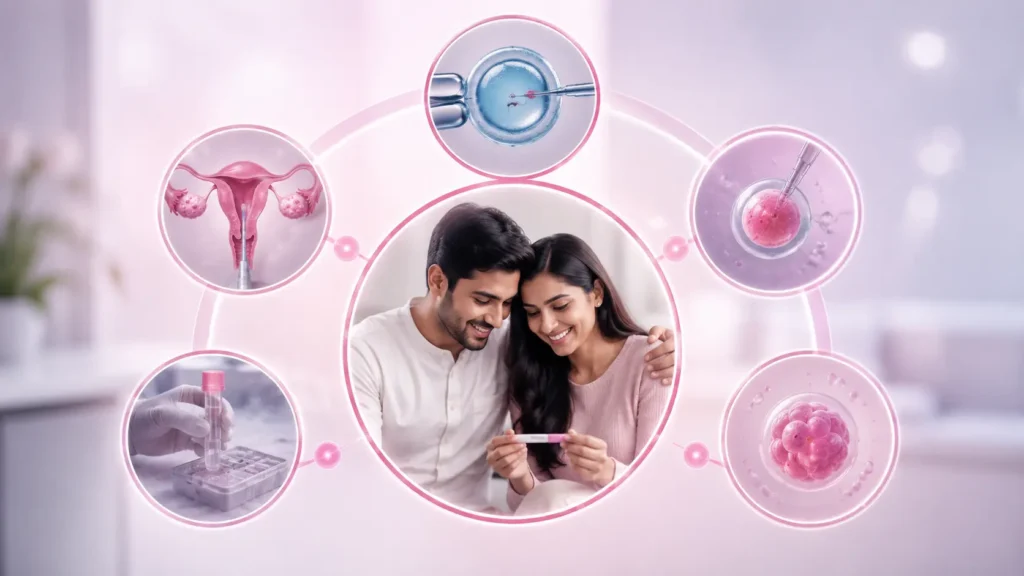
Not every couple needs the same IVF protocol. There are several types of IVF treatment — conventional IVF, ICSI, natural cycle IVF, and mini IVF — and the right choice depends on your age, egg reserve, sperm quality, budget, and medical history.
All types of IVF treatment follow the same basic principle: the egg and sperm are fertilised outside the body in a laboratory, and the resulting embryo is transferred into the uterus. What changes between the types is how much stimulation medication is used and how fertilisation is performed in the lab.
In this guide, we explain each type in simple language, compare success rates and costs, and help you understand which option your fertility specialist is likely to recommend — and why.
| Conventional IVF | Standard protocol — full stimulation, eggs + sperm mixed in lab dish |
| ICSI | IVF + single sperm injected directly into the egg (male infertility) |
| Natural Cycle IVF | No stimulation injections — uses your one natural egg per month |
| Mini IVF | Low-dose stimulation — fewer injections, fewer but quality eggs |
| Best Success Rate | Conventional IVF / ICSI (35–50% per cycle, age dependent) |
| Lowest Medication Load | Natural Cycle IVF, followed by Mini IVF |
Think of these as four routes to the same destination. The destination — a healthy embryo transferred into the uterus — never changes. The route differs in medication dose, number of eggs collected, cost per cycle, and who each protocol suits best. Your doctor selects the route based on your test reports, not on a one-size-fits-all formula.
New to IVF? Start with the basics first: What Is IVF — Complete Guide →
Conventional IVF — The Standard Protocol
Conventional IVF (also called standard IVF or stimulated IVF) is the most widely used type of IVF treatment worldwide, and the protocol most fertility data is based on.
How it works: You take hormone injections for 10–14 days to stimulate the ovaries to produce multiple eggs (typically 8–15) instead of the single egg your body releases naturally. The eggs are retrieved under short anaesthesia, placed in a lab dish with prepared sperm, and fertilisation happens on its own — the sperm penetrates the egg naturally, just in a dish instead of the body. The best embryo is then transferred to the uterus, often at the blastocyst stage (Day 5) for higher success rates.
Who is it for?
- Blocked fallopian tubes — eggs cannot meet sperm naturally
- Endometriosis affecting fertility
- Unexplained infertility after failed IUI cycles
- Good ovarian reserve — your ovaries can respond to stimulation
- Normal or near-normal sperm parameters — sperm can fertilise the egg on its own
Pros: Highest number of eggs and embryos per cycle, spare embryos can be frozen for future attempts, best-documented success rates (35–45% per cycle depending on age).
Cons: More injections, higher medication cost, and a small risk of OHSS (ovarian hyperstimulation syndrome) — which is why monitoring at an experienced, NABH-certified centre matters.
💡 If your doctor says just “IVF” without any prefix — they almost always mean conventional IVF. It remains the default because more eggs generally means more embryos, and more embryos means more chances of pregnancy from a single stimulation.
ICSI vs IVF — What’s the Difference?
This is the most common question couples ask, so let’s clear it up: ICSI is not a separate treatment from IVF — it is a more advanced fertilisation technique used within an IVF cycle.
The stimulation, egg retrieval, embryo culture, and transfer steps are identical. The only difference is what happens in the lab at the fertilisation step:
- Conventional IVF: Thousands of sperm are placed around each egg in a dish, and one sperm fertilises the egg on its own.
- ICSI (Intracytoplasmic Sperm Injection): The embryologist selects a single healthy sperm and injects it directly into the egg using a fine needle under a microscope.
So when do you need ICSI instead of conventional IVF?
- Low sperm count or poor motility — male factor infertility is the number one reason for ICSI
- Abnormal sperm morphology — sperm shape issues that prevent natural penetration of the egg
- Previous failed fertilisation — eggs didn’t fertilise in an earlier conventional IVF cycle
- Surgically retrieved sperm — TESA/PESA cases where sperm numbers are very limited
- Frozen eggs or very few eggs — to maximise fertilisation from each precious egg
← Swipe to scroll →
| Factor | Conventional IVF | ICSI |
|---|---|---|
| Fertilisation | Sperm penetrates egg naturally in a dish | One sperm injected directly into each egg |
| Best For | Tubal, unexplained, female-factor infertility | Male infertility, previous fertilisation failure |
| Fertilisation Rate | 60–70% of mature eggs | 70–80% of mature eggs |
| Success Per Cycle | 35–45% (age dependent) | 40–50% when male factor is the issue |
| Extra Cost | — | ₹20,000–₹40,000 over standard IVF |
Important: ICSI is not “better” than IVF for everyone. If sperm parameters are normal, conventional IVF gives equally good results without the extra cost. ICSI wins specifically when sperm quality is the barrier. Read the full guide: ICSI Treatment — What It Is & When You Need It →
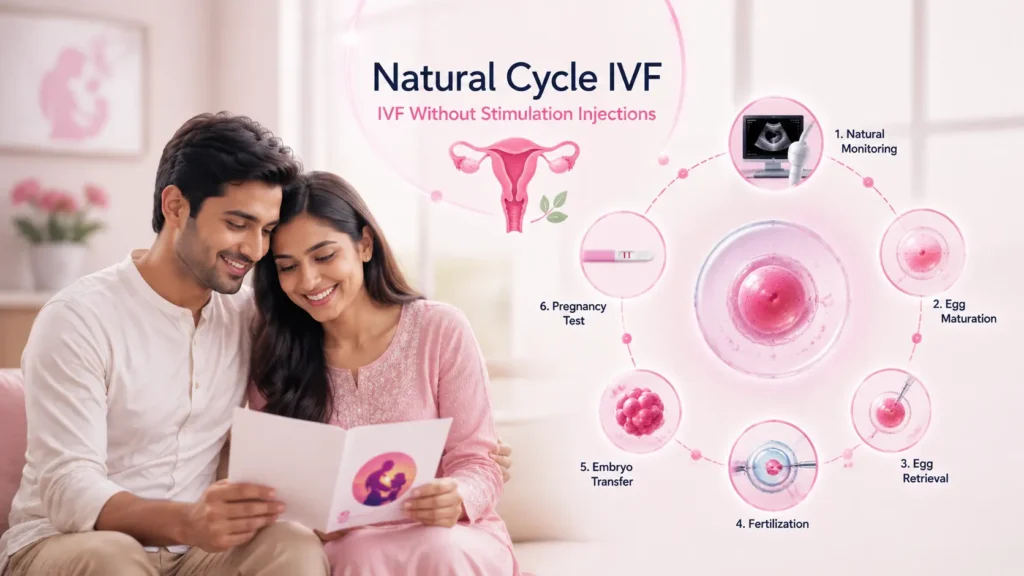
Natural Cycle IVF — IVF Without Stimulation Injections
Natural cycle IVF is exactly what it sounds like: IVF performed on your natural menstrual cycle, without hormone stimulation injections (or with only a trigger shot).
How it works: Each month your body naturally matures one egg. In natural cycle IVF, the doctor monitors your cycle with ultrasounds and blood tests, retrieves that single egg just before ovulation, fertilises it in the lab (with IVF or ICSI), and transfers the embryo. No 10–14 days of injections, no stimulation drugs.
Who is it for?
- Very low ovarian reserve / low AMH — when stimulation would only produce 1–2 eggs anyway, so why take heavy medication?
- Poor responders — women whose ovaries didn’t respond well to stimulation in previous cycles
- Medical contraindications to hormones — e.g., certain hormone-sensitive cancers or clotting conditions
- Personal preference — couples who want a drug-free, more natural approach
- High OHSS risk — eliminating stimulation eliminates OHSS risk entirely
Pros: Zero or minimal medication, much lower cost per cycle (often 40–60% cheaper), no OHSS risk, no injection side effects, can be repeated back-to-back every month.
Cons: Only one egg per cycle means everything depends on that single egg — if it doesn’t fertilise or the embryo doesn’t develop, the cycle ends with nothing to transfer. Success rate per cycle is lower (8–15%), so most patients need multiple cycles.
💡 Honest advice: natural cycle IVF is not a shortcut — it’s a specific tool for specific situations. For a 28-year-old with good egg reserve and blocked tubes, conventional IVF is clearly better. For a 41-year-old with AMH of 0.4, natural cycle or mini IVF may actually be the smarter, gentler strategy.
Mini IVF — Low-Dose, Budget-Friendly Stimulation
Mini IVF (also called minimal stimulation IVF or micro IVF) sits between natural cycle IVF and conventional IVF. Instead of high-dose injections, it uses oral fertility tablets (like Clomiphene or Letrozole) plus very low-dose injections to produce a small number of quality eggs — typically 3 to 5.
How it works: The steps are the same as conventional IVF — stimulation, retrieval, lab fertilisation, embryo transfer — but the medication load is a fraction of the standard protocol. Fewer injections, fewer clinic visits, gentler on the body.
Who is it for?
- Diminished ovarian reserve — high-dose drugs won’t force more eggs from low-reserve ovaries; mini IVF works with what’s there
- Women over 38–40 — where egg quality matters more than egg quantity
- Budget-conscious couples — medication is the biggest variable cost in IVF; mini IVF can cut drug costs by 50–70%. Also see our Low Cost IVF programme
- PCOS patients at high OHSS risk — lower doses mean dramatically lower hyperstimulation risk
- Those who found conventional IVF physically or emotionally exhausting
Pros: 50–70% lower medication cost, far fewer injections, minimal OHSS risk, shorter recovery, and per-embryo quality is often comparable to conventional IVF.
Cons: Fewer eggs means fewer embryos and usually none spare to freeze — so if the first transfer fails, a fresh cycle is needed. Per-cycle success (20–30%) is lower than conventional IVF, though cumulative success over 2–3 cycles can be similar for the right patient profile.
All Types of IVF Compared — One Table
← Swipe to scroll →
| Type | Stimulation | Eggs Retrieved | Best For | Success / Cycle | Approx. Cost (India) |
|---|---|---|---|---|---|
| Conventional IVF | Full dose, 10–14 days injections | 8–15 | Tubal block, endometriosis, unexplained | 35–45% | ₹1,20,000–₹1,80,000 |
| ICSI | Same as conventional | 8–15 | Male infertility, failed fertilisation | 40–50% | +₹20,000–₹40,000 over IVF |
| Natural Cycle IVF | None (trigger shot only) | 1 | Very low AMH, poor responders, drug-free preference | 8–15% | ₹50,000–₹90,000 |
| Mini IVF | Low dose — tablets + few injections | 3–5 | Low reserve, 38+ age, budget, OHSS risk | 20–30% | ₹70,000–₹1,20,000 |
Note: success rates are per-cycle averages and depend heavily on female age and clinic quality. Cumulative success over multiple cycles is what ultimately matters. For a full cost breakdown, read: IVF Cost in India — Full Breakdown →
So, Which Type of IVF is Right for You?
Ask yourself these four questions — they are the same questions your fertility specialist will work through with your reports:
-
Is there a male factor?
If the semen analysis shows low count, poor motility, or abnormal morphology → ICSI is the answer, regardless of which stimulation protocol you use. If sperm is normal → conventional fertilisation is fine.
-
What is your ovarian reserve (AMH)?
Good AMH and antral follicle count → conventional IVF maximises embryos per cycle. Low AMH (below ~1.0) or previous poor response → mini IVF or natural cycle IVF may give equal results with less medication and cost.
-
What is your age?
Under 35 with good reserve → conventional IVF gives the highest per-cycle success. Over 38–40 → egg quality dominates; mini IVF’s gentler approach is often preferred, sometimes combined with back-to-back cycles to bank embryos.
-
What is your budget and medication tolerance?
If cost or fear of injections is the barrier keeping you from starting at all → mini IVF or natural cycle IVF is far better than not trying. EMI options can also make conventional IVF affordable without compromise.
The honest truth: no blog can pick your protocol — your AMH report, semen analysis, ultrasound, and history can. What a good blog can do is make sure you walk into the consultation knowing what to ask. Bring these questions to your doctor: “Why this protocol for me? What’s my expected egg number? What happens if we get fewer eggs than expected?”
Javitri Hospital
All Types of IVF Treatment Under One Roof — Javitri Hospital, Lucknow
At Javitri Hospital, the protocol is chosen to fit the patient — not the other way around. With 30+ years of experience, a NABH-certified lab, and Dr. Rajul Tyagi’s international training (Cleveland Clinic USA and Brussels University — the birthplace of ICSI), every type of IVF discussed above is available in Lucknow:
- ✅ Conventional IVF — with individualised stimulation protocols and blastocyst culture
- ✅ Computerised ICSI — machine-assisted precision that improves fertilisation and success rates
- ✅ Natural Cycle & Mini IVF — gentle, low-cost protocols for low AMH and poor responders
- ✅ 4.9 Google Rating — 1,840+ genuine patient reviews
- ✅ EMI Available — 0% interest over 3, 6, or 12 months
- ✅ Free First Consultation — get a protocol recommendation based on your reports, at no charge
Address (Main Centre): Telibagh Chauraha, Raebareli Road, Lucknow — 226025
Call: +91-9936068274 | Email: info@javitrihospital.co.in
Not Sure Which IVF Type Fits Your Case? Ask Us — Free.
Share your reports in a free consultation and get an honest protocol recommendation. Fully confidential. No pressure.
Keep Reading
Related IVF Guides
→ What Is IVF? — Complete Guide
→ ICSI Treatment — What It Is & When You Need It
📋 In This Article
- Types of IVF — Overview
- Conventional IVF
- ICSI vs IVF
- Natural Cycle IVF
- Mini IVF
- Comparison Table
- Which One is Right?
- Javitri Hospital
- FAQs
Book a free consultation — call us or send a message.
Types of IVF Treatment — Frequently Asked Questions
There are four main types of IVF treatment: conventional IVF (standard full stimulation), ICSI (IVF with direct sperm injection, used for male infertility), natural cycle IVF (no stimulation drugs, one natural egg), and mini IVF (low-dose stimulation, 3–5 eggs). All follow the same core process — fertilisation in the lab followed by embryo transfer — and differ mainly in medication dose and fertilisation technique.
Conventional IVF and ICSI have the highest per-cycle success rates — roughly 35–45% for conventional IVF and 40–50% for ICSI in male-factor cases, depending on the woman’s age. Natural cycle IVF (8–15%) and mini IVF (20–30%) have lower per-cycle rates but can achieve comparable cumulative success over multiple gentler, cheaper cycles for the right patients.
ICSI is not universally better — it is better only when male infertility is the problem. ICSI is IVF with one extra lab step: injecting a single sperm directly into the egg. If sperm parameters are normal, conventional IVF gives equally good results at lower cost. If sperm count, motility, or morphology is poor, ICSI significantly improves fertilisation and is clearly the right choice.
Natural cycle and mini IVF suit women with very low ovarian reserve (low AMH), poor responders to previous stimulation, women over 38–40, those at high OHSS risk (like some PCOS patients), and couples on a tight budget. They use little or no stimulation medication, cost 40–60% less per cycle, and are much gentler on the body — at the cost of fewer eggs per cycle.
Natural cycle IVF is the cheapest (roughly ₹50,000–₹90,000 per cycle) because it needs almost no stimulation medication, followed by mini IVF (₹70,000–₹1,20,000). Conventional IVF costs ₹1,20,000–₹1,80,000 all-in in Lucknow, and ICSI adds ₹20,000–₹40,000. At Javitri Hospital, 0% interest EMI options are available for all protocols. Call +91-9936068274 for a free consultation.
Start the Right IVF Treatment for Your Case
Free consultation. Honest protocol advice. Transparent cost. EMI available. It starts with one call.