
IUI Success Rate by Age
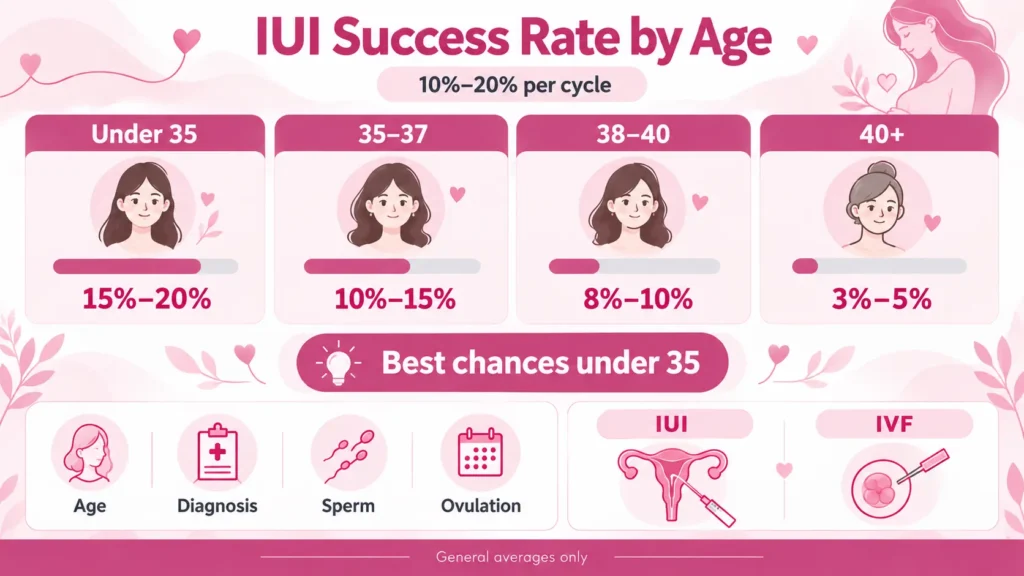
The IUI success rate is generally 10% to 20% per cycle, and it moves most with one thing: the woman’s age. Under 35 the chance sits near the top of that range, and it falls steadily after 35.
IUI, or Intrauterine Insemination, places washed sperm directly into the uterus around ovulation. It gives natural conception a helpful head start rather than taking over the process, which is why its per cycle chance is close to natural conception and why most couples plan for more than one cycle.
This guide explains the IUI success rate honestly, band by band of age, what counts as success, the factors that move the number, and how it compares with IVF. The figures here are general averages, not a promise for any one person, because your own chance depends on your age, diagnosis, and sperm quality.
| Under 35 | About 15% to 20% per cycle |
| 35 to 40 | About 10% per cycle |
| Over 40 | Usually below 5% per cycle |
| Cumulative over 3 cycles | About 35% to 45% for good candidates |
| Usual course | 3 cycles before considering IVF |
| Biggest factors | Age, sperm quality, and how well ovulation is timed |
The most useful idea to hold onto is that IUI is a numbers game played over a short course, not a single attempt. The per cycle figure looks modest because it sits close to natural monthly conception, but the chance builds over the first three cycles. That is why doctors plan IUI as a series rather than a one time try.
What the IUI Success Rate Actually Measures
Before you trust any percentage, it helps to know what is being counted, because clinics do not all measure success the same way.
- Per cycle or cumulative? A per cycle rate is the chance in a single attempt, usually 10% to 20%. A cumulative rate adds up the chance across several cycles, so it is naturally higher. Both are valid, but they answer different questions.
- Positive test, clinical pregnancy, or live birth? A positive pregnancy test is not the same as a baby. The live birth rate is always lower than the pregnancy rate, so check which one a clinic is quoting.
- Natural or stimulated cycle? A stimulated cycle, with tablets or injections to mature one to three eggs, usually has a slightly higher success rate than a natural cycle.
When a clinic quotes a single impressive IUI success rate with no age band and no definition, that missing context is worth asking about. An honest centre will give you a personalised estimate based on your reports rather than one headline figure.
IUI Success Rate by Age, Explained
Age is the strongest single predictor of IUI success, because egg quality declines over time. The IUI success rate in India follows the same age pattern seen in fertility data worldwide.
← Swipe to scroll →
| Age Group | Per Cycle Success | What It Means |
|---|---|---|
| Under 35 | About 15% to 20% | The best chance, often with a stimulated cycle |
| 35 to 37 | Around 10% to 15% | A gentle decline as egg quality changes |
| 38 to 40 | Around 8% to 10% | A steeper fall, fewer cycles advised |
| Over 40 | Usually below 5% | Many specialists suggest moving to IVF |
These are broad averages. A healthy woman of 32 with open tubes and good sperm from her partner sits at the top of her band, while someone of the same age with a borderline sperm count sits lower. After 40, the per cycle chance with IUI drops into the single digits, which is why age is the first thing a specialist weighs when advising IUI or IVF. For the full comparison, read our guide on IUI or IVF, which to choose.
Factors That Affect Your IUI Success Rate
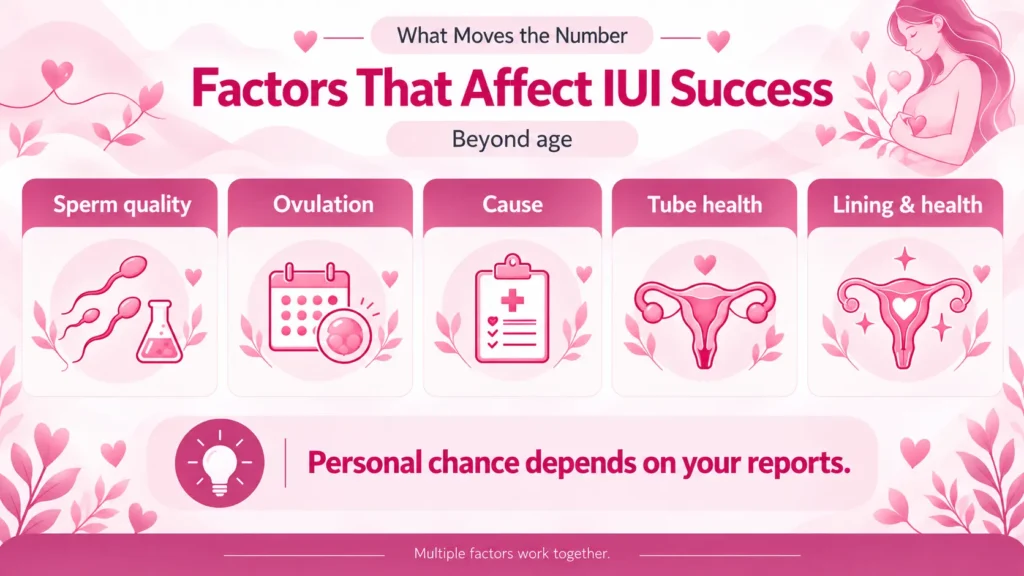
Age gets the headlines, but it is not the whole story. Two women of the same age can have very different chances. These are the main factors a good specialist weighs.
- Sperm quality. IUI needs a reasonable number of healthy, moving sperm after washing. When the washed total motile count is high, the IUI procedure success rate is at its best. A very low count makes IUI unlikely to work, and IVF with ICSI becomes the better option.
- Ovulation and stimulation. A stimulated cycle that matures one to three eggs usually has a higher chance than a natural cycle. Precise timing of the insemination to ovulation matters just as much.
- Cause of infertility. Unexplained infertility, mild male factor, and cervical issues respond best to IUI. Blocked tubes or severe male factor do not, because IUI cannot bypass them.
- Fallopian tubes. At least one open, healthy tube is essential. IUI cannot succeed without it, however many cycles are tried.
- The uterine lining and general health. A receptive lining, a healthy weight, and controlled conditions such as thyroid all support a better chance.
Because these factors interact, the honest answer to your personal chance comes from your reports, not a chart. A semen analysis, an ultrasound, and an ovulation assessment together tell a specialist far more than your age alone. If a semen analysis has flagged concerns, our guidance on male infertility explains what it means for IUI.
How Many IUI Cycles, and Cumulative Success
The single most important number in IUI is not the per cycle figure but the cumulative one, because success builds over a short series of attempts rather than resting on one.
Most IUI pregnancies happen within the first three cycles. For a good candidate, the IUI treatment success rate across three well timed cycles can reach 35% to 45% cumulatively, even though each single cycle sits at 10% to 20%. After three cycles, the added chance from a fourth or fifth attempt falls, and the curve begins to flatten.
💡 This is why specialists plan IUI as a course of three cycles, with a maximum of six for younger women with a good prognosis. If three well monitored cycles have not worked, continuing rarely helps, and the evidence points toward moving to IVF. Spending a year on repeated IUI is one of the most common and costly mistakes, especially after 35 when every month of ovarian reserve matters.
Planning for three cycles from the start also makes the budget realistic. For what that costs, read our breakdown of IUI treatment cost.
IUI vs IVF Success Rates
IVF has a higher success rate per cycle than IUI, which is the main reason couples move from one to the other. The reason is structural, not a question of one being better overall.
← Swipe to scroll →
| Factor | IUI | IVF |
|---|---|---|
| Success per cycle, under 35 | About 15% to 20% | About 40% to 50% |
| How it works | Assists natural conception in the body | Fertilisation in the lab, embryo transferred |
| Best for | Mild, unexplained, mild male factor | Blocked tubes, severe male factor, low reserve |
| Cost per cycle | From ₹20,000 | From ₹95,000 |
IVF is roughly two to three times more effective per cycle because several eggs are used, fertilisation is confirmed in the laboratory, and the best embryo is selected. But IUI is far cheaper and gentler, so for mild cases it is the sensible first step. The right path is about your diagnosis, not just the higher number. For the IVF side, read our guide to the IVF success rate by age.
How to Improve Your IUI Success Rate
You cannot change your age, but a few things genuinely support a better chance within each cycle.
- Get precise ovulation tracking, so the insemination is timed to the fertile window rather than a rough estimate.
- Follow the stimulation protocol exactly, as the right dose of tablets or injections at the right time matters.
- Optimise sperm quality where possible, with a few weeks of healthier habits before the sample, since sperm takes time to mature.
- Maintain a healthy weight and manage conditions such as thyroid or PCOS, which can affect ovulation.
- Reduce smoking and heavy alcohol for both partners, as both lower fertility.
None of these is a magic lever, and any clinic promising a guaranteed result is overselling. What these steps do is make sure each cycle is given its best honest chance, which over a course of three cycles is what matters.
When to Move On From IUI
Knowing when to stop IUI is as important as knowing when to start it. Continuing past the point where it is likely to help wastes both money and fertile time.
Most specialists advise moving to IVF when three well monitored IUI cycles have not resulted in pregnancy, or sooner if there is a clear reason IUI is unlikely to succeed, such as a very low sperm count, blocked tubes, or age over 40. In these situations the IUI success rate is low from the start, and IVF offers a much higher chance per cycle.
This is not a failure. It is the normal, evidence based progression of fertility treatment, and it is the single most common transition point couples reach. An honest specialist will tell you clearly when IUI has had a fair trial and when it is time to consider IVF treatment.
Javitri Hospital
IUI Treatment and Honest Guidance at Javitri Hospital, Lucknow
At Javitri Hospital, IUI is planned around your reports, with a realistic view of your chances rather than a single headline number. Here is what to expect.
- ✅ A personalised, honest estimate of your IUI success based on your age, sperm analysis, and ovulation pattern
- ✅ Precise ovulation monitoring and expert semen preparation in a NABH accredited laboratory
- ✅ Clear advice on a natural or stimulated cycle, and on when IVF is the better next step
- ✅ IUI from ₹20,000, with a written, itemised estimate at your first visit
- ✅ Consultation fees of ₹600 with Dr. Rajul Tyagi, and ₹400 with Dr. Niharika Tyagi and Dr. Lavanya Tyagi
- ✅ Care from Dr. Rajul Tyagi, trained at Cleveland Clinic USA and Brussels University, caring for fertility patients since 1997
Our main centre is at Telibagh, Lucknow, with further clinics at Badshahnagar and in Kanpur.
Address, Main Centre: Telibagh Chauraha, Raebareli Road, Lucknow 226025
Call: +91 99360 68274 | Email: info@javitrihospital.co.in
Want an Honest Estimate of Your IUI Chances?
Bring your reports and get a realistic, personalised view of your IUI success, explained clearly. Transparent advice. EMI available. Fully confidential.
Keep Reading
Related Fertility Guides
→ IUI Treatment in Lucknow, Process and Timing
→ IUI Treatment Cost in Lucknow and India
📋 In This Article
- Success Rate Overview
- What It Measures
- IUI Success Rate by Age
- Factors That Affect It
- Cumulative Success
- IUI vs IVF Success
- Improve Your Chances
- When to Move On
- At Javitri Hospital
- FAQs
Get a personalised IUI assessment. Call us or send a message.
🔗 Related Articles
IUI Success Rate, Frequently Asked Questions
The IUI success rate is generally 10% to 20% per cycle. It is higher for women under 35, around 15% to 20%, dips to about 10% between 35 and 40, and falls below 5% over 40. The figure depends on age, sperm quality, and how precisely ovulation is timed. A stimulated cycle usually has a slightly higher chance than a natural cycle.
By age, the per cycle IUI success rate is roughly 15% to 20% under 35, 10% to 15% between 35 and 37, 8% to 10% between 38 and 40, and below 5% over 40. Egg quality declines with age, which is why the chance falls, and why many specialists advise women over 40 to consider IVF, which offers a much higher chance per cycle.
While a single cycle sits at 10% to 20%, the cumulative IUI success rate across three well timed cycles can reach 35% to 45% for good candidates. Most IUI pregnancies happen within the first three cycles, after which the added chance from further attempts falls. This is why IUI is planned as a short course of three cycles rather than a single try.
Usually, yes. A stimulated cycle uses tablets or injections to mature one to three eggs instead of one, which modestly raises the chance compared with a natural cycle. It also costs more because of the medication. Whether a natural or stimulated cycle suits you is a clinical decision based on your age and ovulation pattern, not a budget choice alone.
After age, sperm quality is the biggest factor. IUI needs a reasonable washed total motile count to work well, so a very low count lowers the IUI procedure success rate and points toward IVF with ICSI. Precise ovulation timing, at least one open fallopian tube, the cause of infertility, and a receptive uterine lining all matter too.
Most specialists recommend a maximum of three IUI cycles, or up to six for younger women with a good prognosis, before moving to IVF. Most IUI pregnancies happen in the first three cycles, after which per cycle success declines while IVF stays far more effective. Continuing IUI beyond this point usually wastes time and money, especially after 35.
The IUI success rate in India is in line with global figures, generally 10% to 20% per cycle depending on age, sperm quality, and the clinic’s timing and laboratory standards. Younger women with a mild diagnosis sit at the top of that range, while success falls after 35 and drops below 5% over 40. Cumulative success over three cycles can reach 35% to 45% for good candidates.
IVF has a higher success rate per cycle. Under 35, IVF is roughly 40% to 50% per cycle while IUI is 15% to 20%, so IVF is about two to three times more effective in a single cycle. This is because IVF uses several eggs, confirms fertilisation in the laboratory, and selects the best embryo. IUI is far cheaper and gentler, so it is the sensible first step for mild, uncomplicated cases.
You cannot change your age, but you can give each cycle its best chance. Precise ovulation timing, following the stimulation protocol exactly, improving sperm quality with a few weeks of healthier habits beforehand, maintaining a healthy weight, managing conditions such as thyroid or PCOS, and reducing smoking and heavy alcohol for both partners all help. No clinic can guarantee a result, so be cautious of any that promises one.
A positive test confirms that implantation has happened, but the outcome that matters is a live birth, and some pregnancies do not continue. This is why the live birth rate is always lower than the pregnancy rate, and why you should check which figure a clinic quotes when it shares an IUI success rate. A positive test is an encouraging step, not the final result.
Understand Your Real IUI Chances, Honestly
A personalised estimate based on your reports, explained clearly. Transparent care. EMI available. It starts with one call.