
Test Tube Baby Process, Steps and Cost
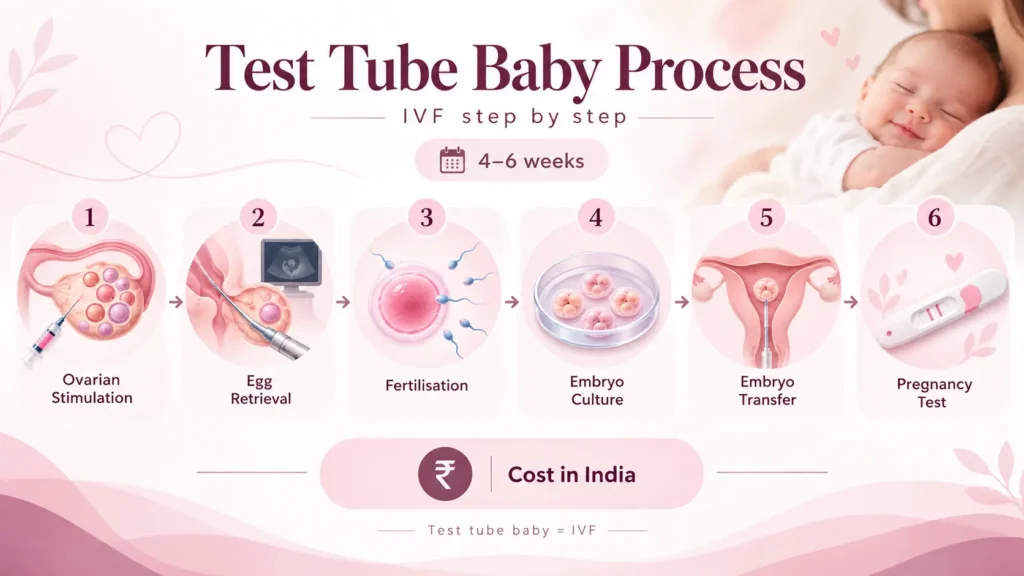
The test tube baby process is the same as IVF. It collects a woman’s eggs and a man’s sperm, joins them in a laboratory to form an embryo, and transfers that embryo into the uterus. One full cycle takes about four to six weeks.
The term test tube baby is simply the everyday name for IVF treatment, which doctors call In Vitro Fertilisation. There is no difference between the two, and this guide explains exactly why, along with every step of the process and what it costs in India.
By the end you will understand how a test tube baby is made step by step, how long each stage takes, the realistic cost, who it is for, and how to give a cycle its best chance. The information here is clear and honest, so you can walk into a consultation knowing what to expect.
| Also known as | IVF, or In Vitro Fertilisation |
| Time for one cycle | About 4 to 6 weeks |
| Main steps | Stimulation, egg retrieval, fertilisation, transfer |
| Cost in Lucknow, all in | ₹1,20,000 to ₹1,80,000 per cycle |
| At Javitri Hospital | From ₹95,000, with 0% interest EMI |
| Is it painful | Mostly comfortable, the transfer needs no anaesthesia |
The single most useful thing to know before you start is that test tube baby and IVF are two names for one treatment. Once that is clear, the process itself is a logical sequence of steps that a good clinic guides you through one at a time. The rest of this guide walks you through each one.
Is IVF and Test Tube Baby the Same?
Yes. IVF and test tube baby are exactly the same treatment, and the question of what is the difference between IVF and test tube baby has a simple answer: there is none. They are two names for one process.
The name test tube baby appeared in 1978, when the world’s first baby conceived this way was born. Newspapers called it a test tube baby because people imagined the baby was made in a glass tube. In reality the egg and sperm are joined in a flat laboratory dish, not a test tube, but the name stuck in everyday language.
So when people search test tube baby vs IVF expecting two different treatments, there is really nothing to compare. Doctors and hospitals say IVF. Families at home often say test tube baby. The process, the steps, and the result are identical. If you ask a clinic for either, you will be offered the same treatment. For the medical explanation, see our full guide on what is IVF.
💡 In short: test tube baby is the common name, IVF is the medical name, and In Vitro Fertilisation is what IVF stands for. All three describe one treatment. The word vitro comes from the Latin for glass, which is where the test tube idea came from.
The Test Tube Baby Process, Step by Step
The test tube baby process follows a clear sequence over about four to six weeks. Here is what happens at each stage.
-
Tests and planning
Both partners have tests first, including hormone levels, an AMH test, a semen analysis, and an ultrasound. Your specialist uses these to design the right protocol for you and to confirm that IVF is the best option.
-
Ovarian stimulation
For about 10 to 14 days, the woman takes hormone injections that encourage the ovaries to mature several eggs instead of the single egg a natural cycle produces. Monitoring scans track how the follicles are growing.
-
Egg retrieval
When the eggs are ready, they are collected in a short day procedure under light anaesthesia, so it is not painful. This usually takes about twenty minutes, and you go home the same day.
-
Fertilisation in the laboratory
The eggs are joined with sperm in the laboratory. In standard IVF the sperm fertilises the egg on its own in a dish. When there is a male factor, a single sperm is injected into each egg using ICSI.
-
Embryo culture
The fertilised eggs, now embryos, grow in the laboratory for three to five days. Culturing to the day five blastocyst stage allows the strongest embryo to be selected for transfer.
-
Embryo transfer
The best embryo is placed into the uterus through a thin catheter. This step is quick and painless, similar to a routine internal examination, and needs no anaesthesia.
-
The two week wait and pregnancy test
About two weeks after the transfer, a blood test confirms whether the cycle has resulted in a pregnancy. This waiting period is emotional, and that is completely normal.
For a deeper look at each stage, read our detailed guide on the IVF process.
Test Tube Baby Process Timeline
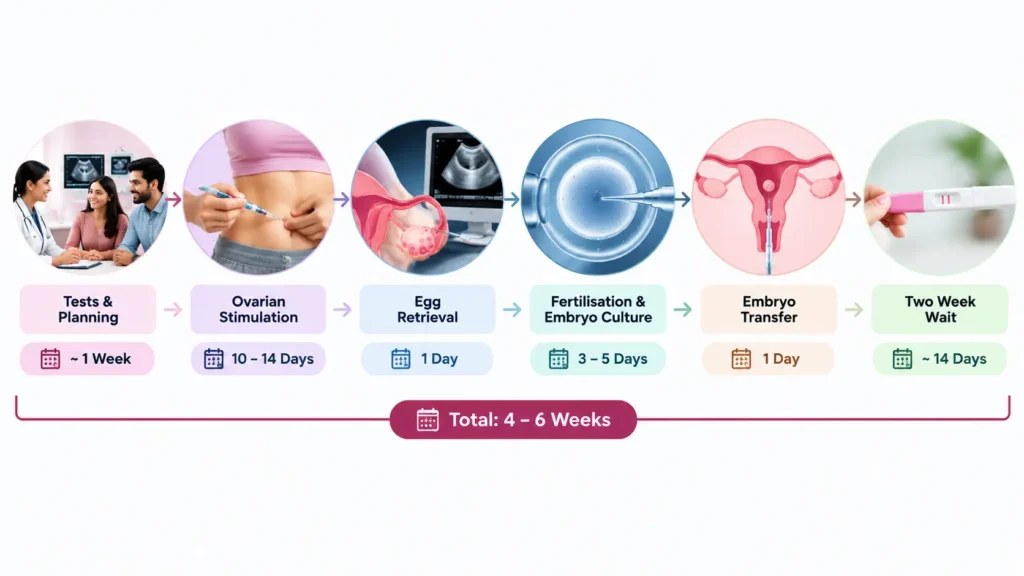
One full test tube baby cycle takes about four to six weeks from the start of stimulation to the pregnancy test. Here is how the time is spread across the stages.
← Swipe to scroll →
| Stage | How Long |
|---|---|
| Tests and planning | About 1 week, before the cycle |
| Ovarian stimulation | 10 to 14 days of injections |
| Egg retrieval | A single day procedure |
| Embryo culture | 3 to 5 days in the laboratory |
| Embryo transfer | A single, quick procedure |
| Two week wait | About 14 days to the pregnancy test |
If spare embryos are frozen, a later frozen embryo transfer in a separate cycle takes less time, because it skips the stimulation and retrieval stages. Your specialist will give you a personalised timeline based on your protocol.
Test Tube Baby Cost in India
The test tube baby cost in India is the same as the IVF cost, since they are the same treatment. For one complete cycle in a city like Lucknow, the all in figure is generally ₹1,20,000 to ₹1,80,000, with metro cities costing more.
| Base procedure only | ₹85,000 to ₹1,20,000 |
| Stimulation medication (separate) | ₹30,000 to ₹80,000 |
| ICSI, if a male factor is present | ₹20,000 to ₹40,000 extra |
| All in, one cycle in Lucknow | ₹1,20,000 to ₹1,80,000 |
| All in, Delhi or Mumbai | ₹1,80,000 to ₹3,00,000 |
| EMI available | Yes, 0% interest at Javitri Hospital |
The headline package price usually covers the base procedure only. Stimulation medication is the biggest variable and is almost always billed separately, so always ask for a written, itemised estimate. Lucknow is meaningfully more affordable than the metros for the same quality at an accredited centre. For a full breakdown, read our guide to IVF cost in Lucknow.
Who Needs a Test Tube Baby Procedure?
A test tube baby procedure is not the first step for every couple. Doctors usually try simpler treatments first and recommend IVF when it is the right option for the situation. It is commonly advised for:
- Blocked or damaged fallopian tubes, where the egg cannot meet the sperm naturally.
- Severe male factor infertility, such as a very low sperm count or poor motility, usually with ICSI.
- Endometriosis that is affecting fertility.
- Low ovarian reserve, or a woman over 38 where time matters.
- Unexplained infertility, or when simpler treatments such as IUI have not worked.
If you have been trying to conceive for a year without success, or six months if the woman is over 35, it is worth seeing a fertility specialist. They will advise whether a test tube baby procedure is right for you, or whether a simpler option fits first.
Test Tube Baby Success Rate
Success depends most on the woman’s age, because egg quality declines over time. These are general ranges for a single cycle using the woman’s own eggs, not a promise for any individual.
- Under 35: roughly 40% to 50% per cycle.
- 35 to 37: roughly 30% to 40% per cycle.
- 38 to 40: roughly 20% to 30% per cycle.
- Over 40: lower, and often needing more than one cycle with the woman’s own eggs.
Success is best understood across two or three cycles rather than a single attempt, and frozen embryos from one stimulation can provide extra transfers. The laboratory and the specialist’s experience also matter a great deal, which is why an accredited centre is worth choosing. For the full picture, read our guide on the IVF success rate by age.
How to Prepare for a Test Tube Baby Cycle
You cannot change your age, but a few steps genuinely support a healthier cycle for both partners.
- Start a few months early where possible, since eggs and sperm take weeks to mature, so healthier habits now help later.
- Maintain a healthy weight, as both a high and a very low body weight can lower success.
- Reduce smoking and heavy alcohol for both partners, as both affect fertility.
- Manage conditions such as thyroid, diabetes, or PCOS with your doctor before the cycle.
- Choose an accredited centre with a strong laboratory, because the embryology lab has an outsized effect on the outcome.
None of these is a magic lever, and any clinic promising a guaranteed result is overselling. What they do is make sure each cycle is given its best honest chance.
Javitri Hospital
Test Tube Baby Treatment in Lucknow at Javitri Hospital
At Javitri Hospital, the test tube baby process is handled with clear pricing, a strong laboratory, and an honest view of your chances. Here is what to expect.
- ✅ Test tube baby treatment from ₹95,000, with a written, itemised estimate at your first visit
- ✅ A NABH accredited laboratory, with the first Embryoscope in Uttar Pradesh, blastocyst culture, and computerised ICSI
- ✅ An honest, personalised view of your chances based on your reports, not a generic figure
- ✅ Consultation fees of ₹600 with Dr. Rajul Tyagi, and ₹400 with Dr. Niharika Tyagi and Dr. Lavanya Tyagi
- ✅ 0% interest EMI across 3 month, 6 month, and 12 month plans
- ✅ Care from Dr. Rajul Tyagi, trained at Cleveland Clinic USA and Brussels University, caring for fertility patients since 1997
Our main centre is at Telibagh, Lucknow, with further clinics at Badshahnagar and in Kanpur.
Address, Main Centre: Telibagh Chauraha, Raebareli Road, Lucknow 226025
Call: +91 99360 68274 | Email: info@javitrihospital.co.in
Thinking About a Test Tube Baby? Get a Clear Plan.
Bring your reports and get an honest view of your chances and a written, itemised cost. Transparent pricing. EMI available. Fully confidential.
📋 In This Article
- Overview
- Is IVF and Test Tube Same
- The Process Step by Step
- Timeline
- Test Tube Baby Cost
- Who Needs It
- Success Rate
- How to Prepare
- At Javitri Hospital
- FAQs
Get a clear test tube baby plan. Call us or send a message.
🔗 Related Articles
Test Tube Baby Process, Frequently Asked Questions
The test tube baby process is the same as IVF. Eggs are collected from the woman after hormone stimulation, joined with sperm in a laboratory to form an embryo, and the embryo is transferred into the uterus. The main steps are tests and planning, ovarian stimulation, egg retrieval, fertilisation, embryo culture, embryo transfer, and a pregnancy test two weeks later. One cycle takes about four to six weeks.
Yes, IVF and test tube baby are the same treatment. Test tube baby is the everyday name, and IVF, or In Vitro Fertilisation, is the medical name. The process, the steps, and the result are identical. The term test tube baby comes from 1978, when people imagined the baby was made in a glass tube, although it is actually a laboratory dish.
There is no difference between IVF and test tube baby. They are two names for one treatment. Doctors and hospitals say IVF, while families at home often say test tube baby. If you ask a clinic for either, you will be offered the same process, so there is nothing to choose between them.
The test tube baby cost in India is the same as the IVF cost, since they are one treatment. One complete cycle in a city like Lucknow is generally ₹1,20,000 to ₹1,80,000 all in, while Delhi and Mumbai cost ₹1,80,000 to ₹3,00,000. The base procedure is ₹85,000 to ₹1,20,000, with stimulation medication billed separately. At Javitri Hospital, treatment starts from ₹95,000 with 0% interest EMI.
One full test tube baby cycle takes about four to six weeks, from the start of stimulation to the pregnancy test. This includes about a week of tests beforehand, 10 to 14 days of stimulation injections, a day for egg retrieval, three to five days of embryo culture, the transfer, and a two week wait for the result. A later frozen embryo transfer takes less time.
The test tube baby process is mostly comfortable. The egg retrieval is done under light anaesthesia, so you feel nothing during it, and the embryo transfer is quick and painless, similar to a routine internal examination, with no anaesthesia needed. Most discomfort comes from the stimulation injections and mild bloating, which settle quickly. It is far easier than many couples fear beforehand.
Success depends most on the woman’s age. Using her own eggs, the chance per cycle is roughly 40% to 50% under 35, 30% to 40% at 35 to 37, 20% to 30% at 38 to 40, and lower over 40. These are general ranges, not a promise. Success is best measured across two or three cycles, and frozen embryos can provide extra transfers from one stimulation.
A test tube baby procedure is commonly advised for blocked fallopian tubes, severe male factor infertility, endometriosis affecting fertility, low ovarian reserve or age over 38, and unexplained infertility or when simpler treatments such as IUI have not worked. If you have been trying for a year without success, or six months if the woman is over 35, it is worth seeing a fertility specialist.
The choice is clinical, not personal preference. In standard IVF, the sperm fertilises the egg on its own in the dish. When there is a male factor, such as a low count or poor motility, a single sperm is injected into each egg using ICSI, which improves fertilisation. Your semen analysis decides which is used, so the specialist recommends ICSI only when there is a reason for it.
You cannot change your age, but you can prepare well. Start healthier habits a few months early, since eggs and sperm take weeks to mature, maintain a healthy weight, reduce smoking and heavy alcohol for both partners, and manage conditions such as thyroid or PCOS before the cycle. Above all, choose an accredited centre with a strong laboratory, because the lab has a large effect on the outcome.
Start Your Test Tube Baby Journey With Confidence
An honest view of your chances, a clear step by step plan, and transparent cost. 0% interest EMI available. It starts with one call.