Trigger Shot in IVF — What It Is and When It’s Given
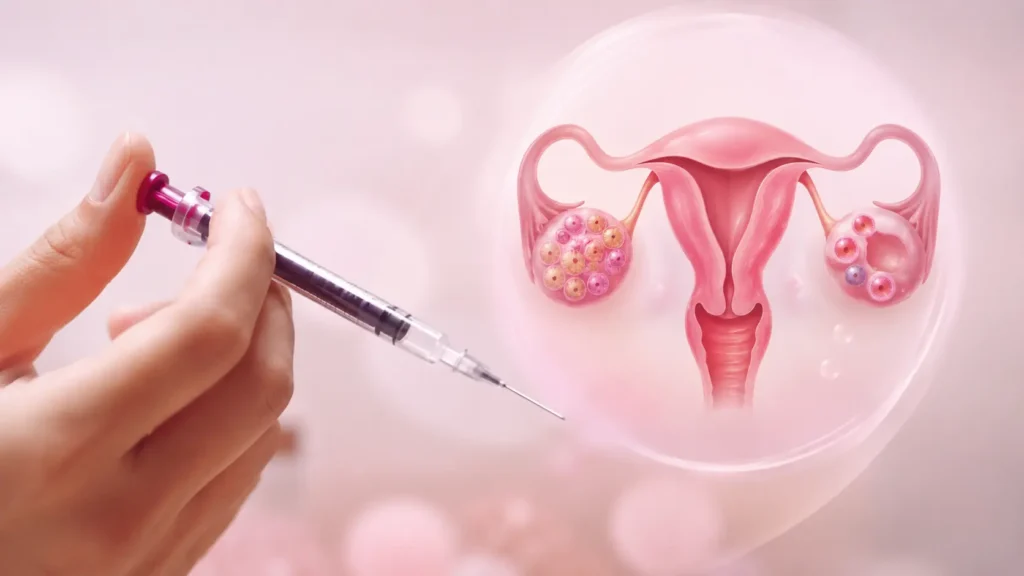
The trigger shot in IVF is a single injection given after the stimulation phase to complete the final maturation of eggs before retrieval. It contains hCG or a GnRH agonist. Without it, eggs remain immature and cannot be fertilised. It is given once, at a precise hour, and egg retrieval follows exactly 34–36 hours later.
What Is the Trigger Shot in IVF?
The trigger shot — also called the trigger injection or final maturation injection — is a hormone injection given at the end of the ovarian stimulation phase. Its job is to trigger the final 36-hour maturation process that each egg needs before it can be retrieved and fertilised.
During the stimulation phase, daily gonadotropin injections grow multiple follicles, each containing an immature egg. The trigger shot gives the signal — mimicking the body’s natural LH surge — that tells each egg to complete its final maturation steps. Without it, eggs remain immature and cannot be fertilised, even with ICSI.
💡 Key fact: The trigger shot is given once only, at a specific hour set by your clinic. Egg retrieval is then scheduled exactly 34–36 hours after that injection. The clinic plans the retrieval appointment around your trigger time — not the other way around.
When Is the Trigger Shot Given?
The trigger shot is given when the leading follicles reach 17–20mm in diameter on ultrasound monitoring — typically after 9–12 days of stimulation injections. Your specialist makes this decision at a morning monitoring scan. The injection is then scheduled for a specific hour (often 9 PM–midnight) so egg retrieval takes place the following morning, exactly 34–36 hours later.
Why the 34–36 Hour Window?
The trigger shot starts the final maturation process. Left to run naturally, the body would ovulate approximately 36–40 hours after the LH surge. Egg retrieval is timed to happen just before natural ovulation — so the eggs are fully mature but still safely inside the follicles.
- Under 34 hours — eggs may not yet be fully mature; fertilisation rates drop
- 34–36 hours (on time) — eggs are mature and retrievable; optimum outcome
- Over 36 hours — eggs may have already ovulated and cannot be retrieved
💡 At Javitri Hospital: The trigger shot time is confirmed at your monitoring appointment and communicated clearly in writing — including the exact hour to inject. Our team is available to confirm before you take the injection.
Types of Trigger Shot — hCG vs GnRH Agonist
There are two main types of trigger shot. Your specialist chooses based on your stimulation response, follicle count, and OHSS risk before the cycle begins.
1. hCG Trigger (Standard) — Ovitrelle 250mcg or Pregnyl 10,000 IU
- Contains human chorionic gonadotropin — mimics the natural LH surge
- Given subcutaneously (pen device) or intramuscularly depending on brand
- Standard choice for most IVF patients
- Longer action — supports the early luteal phase
- Higher OHSS risk in patients with PCOS or high follicle count
- Can cause false-positive urine pregnancy test for up to 14 days
2. GnRH Agonist Trigger (OHSS-safe) — Lupride 0.2mg or Decapeptyl
- Triggers a natural LH + FSH surge from the pituitary gland
- Significantly lower OHSS risk — preferred for high-responders and PCOS patients
- Often used in freeze-all cycles where a FET will follow in a later cycle
- Does not cause false-positive home pregnancy test
How to Give the Trigger Shot
The trigger shot is given as a subcutaneous injection into the lower abdomen for most medications — the same technique as the stimulation injections. Some hCG preparations (Pregnyl) require an intramuscular injection into the thigh or buttock. Most patients self-administer at home at the precise time specified by the clinic.
Step-by-Step
- Take the medication out of the fridge 20–30 minutes before injecting — room temperature reduces discomfort
- Wash hands thoroughly
- Clean the injection site with an alcohol swab; allow to dry
- Pinch a fold of skin on the lower abdomen; avoid the belly button area
- Insert the needle at 90° and inject slowly
- Apply light pressure after — do not rub the site
- Dispose of needle safely in a sharps container
- Note the exact time of injection — your clinic will ask
💡 If you are uncomfortable self-injecting: call the clinic and a nurse can administer it for you. Never skip or delay the trigger injection without speaking to the clinic first. Worried about the injections themselves? Read: Is IVF painful?
Questions About Your IVF Injections?
Our team walks you through every injection — including the trigger shot — before your cycle begins.
What Happens After the Trigger Shot?
After taking the trigger shot, you stop all stimulation injections. The eggs spend the next 34–36 hours completing final maturation inside the follicles, which are now at peak size. You may notice increased bloating and abdominal pressure — this is entirely normal and resolves quickly after egg retrieval when the follicles deflate.
TRIGGER TO RETRIEVAL — TIMELINE
Trigger (Hour 0) — Final Egg Maturation Begins
Take the injection at the exact time specified by the clinic. Note the time — your clinic will ask.
Hour 6–12 — Hormonal Cascade
Hormonal signals cascade through the follicles. Normal activity; expect increased bloating.
Hour 12–24 — Final Meiotic Divisions
Eggs are completing their final meiotic divisions. Rest well. Light food. No alcohol.
Hour 34–36 — Retrieval Window
Eggs are mature and ready. Arrive at the clinic; egg retrieval (OPU) is performed under sedation.
After Retrieval — Recovery
Follicles deflate; bloating resolves within 24–48 hours. Rest at home and take prescribed medications.
Side Effects of the Trigger Shot
The trigger shot injection itself rarely causes significant pain. The side effects patients notice are mainly from the large, mature follicles rather than the injection.
- 🫃 Increased bloating and abdominal fullness — ovaries at maximum size. Loose clothing helps. Resolves after retrieval.
- 🤢 Mild nausea — particularly with hCG trigger. Small meals and hydration help.
- 🫀 Breast tenderness — due to elevated hormones. Temporary.
- ⚠️ OHSS risk (hCG trigger) — women with PCOS or many follicles have higher risk. GnRH agonist trigger is used when this risk is significant.
- 🧪 False-positive home pregnancy test — hCG trigger can cause a positive urine test for up to 14 days. Always use the clinic blood test for the actual result.
What If You Miss or Delay the Trigger Shot?
Missing or delaying the trigger shot is the most serious mistake at this stage of the IVF process. If the trigger is significantly delayed or missed, eggs may ovulate spontaneously before retrieval — meaning no eggs are collected and the cycle is lost.
If you realise you have missed the time, taken the wrong dose, or are uncertain:
- Do not take it late without guidance — call the clinic immediately
- The clinic will advise whether retrieval can proceed, be adjusted, or whether the cycle needs a different approach
- In some cases a small delay is manageable — only your specialist can make this call
⚠️ Call Immediately: If you have any doubt about whether you took the trigger shot correctly — wrong time, wrong dose, or forgotten — call Javitri Hospital on +91-9936068274 straight away. Do not wait. This is the most time-critical moment of the IVF cycle.
When to Contact Your Clinic After the Trigger Shot
- Severe abdominal pain or significant bloating — beyond normal fullness — in the hours after the trigger shot
- Any uncertainty about the trigger injection — wrong time, wrong dose, or forgotten
- Sudden sharp pelvic pain — could indicate early spontaneous ovulation
- Shortness of breath, chest pain, or very reduced urine output
- Fever above 38°C
Ready to Start IVF at Javitri Hospital?
Every injection, every scan, every decision — explained clearly before you begin. NABH certified. 4.9★ Google.
📋 Contents
- What Is the Trigger Shot in IVF?
- When Is the Trigger Shot Given?
- Types of Trigger Shot — hCG vs GnRH Agonist
- How to Give the Trigger Shot
- What Happens After the Trigger Shot?
- Side Effects of the Trigger Shot
- What If You Miss or Delay the Trigger Shot?
- Frequently Asked Questions
Book a free consultation — call or send a message.
Trigger Shot in IVF — FAQs
The trigger shot in IVF is a single hormone injection given at the end of the stimulation phase to complete the final maturation of eggs before retrieval. It contains either hCG (Ovitrelle or Pregnyl) or a GnRH agonist (Lupride or Decapeptyl). Without the trigger shot, eggs remain immature and cannot be fertilised — making it one of the most critical injections in the entire IVF process.
The trigger shot is given when the leading follicles reach 17–20mm on ultrasound — typically after 9–12 days of stimulation injections. The injection is taken at a precise hour set by the clinic (often late evening), and egg retrieval is scheduled exactly 34–36 hours afterwards. The exact timing is confirmed at a monitoring scan and communicated clearly to the patient before trigger day.
The trigger shot starts a 36-hour maturation process, after which the eggs would naturally ovulate. Egg retrieval must happen within the 34–36 hour window — before spontaneous ovulation. Too early and eggs are not mature. Too late and eggs may have already been released where they cannot be collected. This narrow window makes the trigger shot the most precisely scheduled injection in IVF.
Two types: (1) hCG trigger (Ovitrelle 250mcg or Pregnyl 10,000 IU) — the standard choice for most patients, given subcutaneously or intramuscularly. It has longer action and supports the luteal phase but carries higher OHSS risk in high-responders. (2) GnRH agonist trigger (Lupride 0.2mg or Decapeptyl) — preferred for PCOS patients or high follicle counts, as it carries significantly lower OHSS risk. Often used in freeze-all cycles.
Most trigger shots are subcutaneous injections into the lower abdomen — the same technique as the stimulation injections. Ovitrelle comes as a pre-filled pen device, making it easy to self-administer at home. Some hCG preparations require an intramuscular injection. Your clinic nurse demonstrates the technique during the stimulation phase, and the team is available by phone at the moment of injection if needed.
After the trigger shot, you stop all stimulation injections. The eggs spend the next 34–36 hours completing final maturation inside the follicles. You may notice increased bloating as the ovaries are at peak size. Egg retrieval is performed at the clinic under IV sedation exactly 34–36 hours after your trigger injection. Bloating resolves quickly after the follicles are aspirated.
Yes — most patients self-administer the trigger shot at home at the exact time specified by the clinic. Subcutaneous shots like Ovitrelle use a pre-filled pen that is easy to use. Your nurse will demonstrate the technique during the stimulation phase. If you are uncomfortable injecting yourself, the clinic can administer it for you. Never skip or delay without calling the clinic first.
Common side effects: increased abdominal bloating (ovaries at maximum size), breast tenderness, and mild nausea — all resolve after egg retrieval. The main risk with hCG trigger is OHSS, particularly in women with PCOS or many follicles. A GnRH agonist trigger is used when OHSS risk is high. hCG trigger can also cause a false-positive home urine pregnancy test for up to 14 days after injection.
Missing or delaying the trigger shot is a serious issue — eggs may ovulate spontaneously before retrieval if the timing is too late, meaning no eggs are collected and the cycle is lost. If you realise you have taken it at the wrong time, wrong dose, or forgotten, call Javitri Hospital on +91-9936068274 immediately. Do not take it late without guidance. Your specialist will advise whether the cycle can proceed.
At Javitri Hospital, every IVF cycle is managed with personalised monitoring — follicle tracking scans, estradiol blood levels, and individual trigger shot timing are all tailored to your response. Dr. Rajul Tyagi’s 30+ years of IVF experience, training at Cleveland Clinic USA and Brussels University, and our NABH-certified laboratory ensure every decision — including trigger timing and type — is made to maximise your chance of success. Call +91-9936068274 to book a free consultation.
Ready to Start IVF at Javitri Hospital, Lucknow?
We’ll walk you through exactly what to expect, before, during, and after each stage. Free consultation available.